
Stranded in Paradise
We were supposed to be home in five weeks. In reality, we stayed for nearly eight. Stranded in paradise, in Sri Lanka. And the morning that finally made sense of everything, had peacocks calling through the dark, a purple-faced langur monkey watching us from above, and not a single word spoken between us.
But we need to go back to the beginning.
The Notification I Didn’t Mention to Mel
We were in the back of a PickMe Prius, bags loaded, thirty-seven days of Sri Lanka behind us, heading for Colombo’s Bandaranaike International Airport. The plan was simple: Colombo to Riyadh on Sri Lankan Airlines, connect with British Airways, and home. Business class. A glass of something cold. Done.
My phone buzzed. BBC Breaking News: airstrikes had hit Iran.
I looked at Mel, (already quietly anxious about transiting Saudi Arabia) and said nothing.
By the time we reached the Departures entrance, it was clear something was seriously wrong. The Sri Lankan Airlines check-in desk was buzzing with hushed conversations and urgent phone calls. Word was spreading fast: flights through the Gulf were being grounded.
I put on my most reassuring face. “Riyadh is miles from Doha, Dubai, Abu Dhabi,” I said. “We’ll be fine.” And for a while, it seemed I was right: staff confirmed flights to Saudi Arabia were departing as normal. We checked in, cleared immigration, and settled into the Serendib Business Class lounge with a glass of frankly uninspiring champagne, trying to make sense of what was unfolding on the news.
Champagne and Chaos
The lounge had that uneasy atmosphere of a place where people are pretending everything is normal when it clearly isn’t. Across from us, a French family sat in tight formation. The youngest daughter, perhaps seven or eight, was in tears, clinging to her father. I spent ten minutes with him trying to map out alternative routing options, suggesting Singapore, Bangkok, anything avoiding the Gulf. The irony that our own options were about to collapse around us was not yet apparent.
Then came the delay announcement. Then the cancellation.
Within the space of an hour, we’d gone from “departing as normal” to stranded in a foreign country with no clear idea who was responsible for us, where we’d sleep, or how we’d get home.
Who’s Looking After Us?
I went straight to British Airways via their chat facility. To their credit, I got through to a human quickly. Their position, though, was maddening in its logic: we were “checked in,” which meant we were technically en route, which meant they couldn’t intervene until we were formally “offboarded.” But I wasn’t offboarding until I had guarantees in place. Circular doesn’t begin to cover it.
Sri Lankan Airlines, meanwhile, just wanted us out. Out of the lounge first: then off their books as fast as possible. We pushed back: we were mid-discussion with their OneWorld partners, we had Wi-Fi here, and we had nowhere confirmed to sleep. It made no difference.
There is your baggage. Have a nice day.
The Friend Who Saved Us
Outside, bags piled around us in the Arrivals chaos, I did what any stranded traveller should do: I WhatsApp’d someone who actually knew what they were doing.
Ayendra was a contact introduced through my son’s tea business connections in London: one of those extraordinary Sri Lankan fixers who seems to know everyone and can solve anything. I sent a message that would look embarrassingly helpless in hindsight:
“Big problem. All flights grounded and Sri Lanka airlines have said it’s up to us to find a hotel and a flight home. Any suggestions where best to stay (Colombo or Negombo?)”
Two minutes later:
“Let me see quickly. Jetwing Negombo is my suggestion. Let me check and let you know ASAP.”
Seven minutes after that: a hotel name. Eight minutes after that: direct contact details for the hotel manager.
Seventeen minutes from crisis to concrete solution. That is what genuine local connection looks like and why I will always champion building those relationships over relying on faceless booking platforms alone.
Airport Chaos
Somewhere in the chaos that followed — retrieving luggage from Arrivals, BA attempting to rebook us, thousands of fellow passengers now in the same situation, we ordered a PickMe and headed the 7km to Jetwing Blue. By 8:30pm, I was messaging Ayendra to say we were in the taxi. By the end of the evening, we had a flight rebooked to Doha on 2nd March, a backup option via Malé to a direct BA service on the 3rd, and a room that Ayendra had personally secured through a call to the Chairman of Jetwing, a long-time friend. The last room in the hotel. Ayendra, I owe you big time!
In reception as we checked in, a British couple stood ashen-faced. The woman was in tears. They had nowhere to go that night.
We knew exactly how lucky we were.
Finding Sanctuary, while Stranded in Paradise
Jetwing Blue was perfectly fine, and Roshell (who looked after us that evening and again at breakfast) was a genuinely comforting presence in a disorienting situation. But it wasn’t where we wanted to be. Five weeks in Sri Lanka had quietly but fundamentally changed our relationship with accommodation: we had fallen, definitively and irrevocably, for small, boutique, deeply personal places. A large hotel, however welcoming the staff, no longer felt right.
So, I opened Agoda (routed through Avios, naturally — [if you’re not doing this, read this first] (https://hindlesworld.com/british-airways-avios-companion-voucher-guide/)), filtered for small hotels with pools near Negombo, and found Agandau House. Booked for two nights. Checked out at noon and ordered another PickMe.
We ended up staying six nights.
The Agandau Tribe
Arriving at Agandau House felt like stepping through a portal. With the magnificent double staircase, the sliding doors revealed a stunning pool with a magnificent view across Negombo Lagoon.
The distant sound of planes lifting off from CMB airport, and a cast of characters that would have been implausible in a novel.
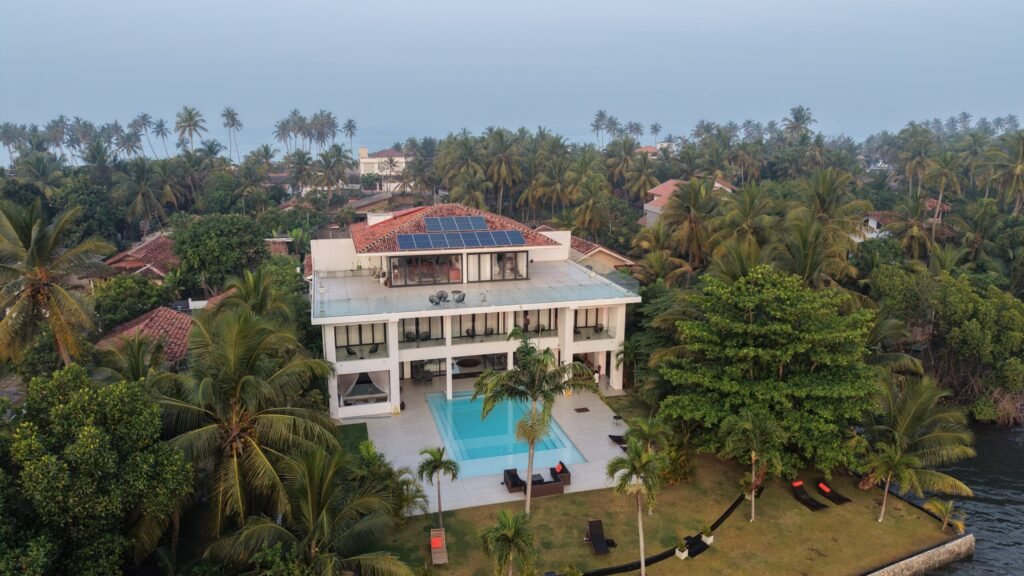
Four young Germans who’d arrived the night before but now had no room to extend into as we’d taken the last one. Two English couples. A Dutch couple. A rotating cast of fellow strandees at various stages of acceptance, panic, and creative problem-solving.
Within 48 hours, we were the best of friends.
Louise, who runs Agandau House, was quite simply extraordinary. She seemed to understand instinctively that what people needed wasn’t just logistics: it was humanity. Musicians were arranged for evening sessions: jazz one night, classical the next. Mel and a Dutch guest – who would become genuinely lifelong friends – were taken on an afternoon trip into Colombo. All of us were led across the road to sit on the beach with sparkling wine and watch the Indian Ocean swallow the sun.
It was, in the truest sense, the Dunkirk spirit. Nobody wasted energy on what they couldn’t control. We shared flight-search tips, routing options, visa hacks. We watched each other’s bags, swapped restaurant recommendations, and kept each other sane. Slowly, one by one, our fellow strandees made their circuitous journeys home – via Bangkok, Singapore, Turkey – and we cheered each departure from the courtyard.
The Indian Visa Nightmare
As it gradually became clear that our Qatar routing was increasingly theoretical [no one was flying into Qatari airspace, and every booking there was effectively meaningless], I turned to Plan B: India.
All day, every day, planes climbed out of Colombo heading north. Mumbai, Delhi, Chennai. India was the logical gateway home, with dozens of direct connections to Europe from multiple cities. The problem: visa. You can’t get one on arrival, you have to pre-apply and it can take days.
I started the application on Tuesday 3rd March. Methodical, precise, exact documents uploaded.
On the 5th: *”Your photo is not sufficiently clear. Please upload another.”*
On the 6th: my visa was granted.
Why is it so hard?
I had followed the identical process for Mel’s application. Her photo was rejected, but this time with no option to re-upload. I had to begin from scratch.
If you’ve never attempted an Indian visa online, it is not a joyful experience at the best of times. On a phone, under time pressure, with restrictions on file size and format that seem designed to defeat you. I’d used Claude.ai to resize passport photos and documents to meet the upload specifications, which helped – but the process itself is a bureaucratic labyrinth. I restarted Mel’s application. Completed every page. Got to the payment gateway just as dinner arrived on the table.
I left it briefly. You can probably see where this is going.
The following morning: “Insufficient time between payment and travel date.” Application void. Start again.
I have nothing printable to add about the Indian visa portal.
Skyscanner, BA Gold, and the Route That Actually Worked
When you and thousands of others are simultaneously trying to thread OneWorld-compatible routes home through closed Middle East airspace, Skyscanner becomes your most important app. Google Flights helped, but Skyscanner’s multi-route view made it easier to spot what others were missing: Turkey, China, Japan, Mumbai.
Mumbai was the one.
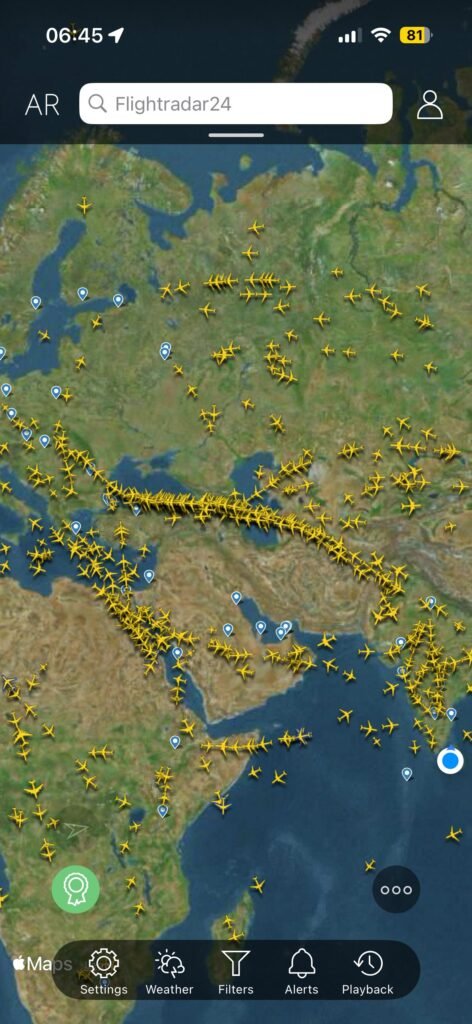
Sri Lankan Airlines flies Colombo to Mumbai at least once daily. Mumbai to Heathrow is a straightforward BA service. The connection existed. There was space.
I’d been avoiding calling BA directly – their chat facility had been reliable, and their UK line costs £2.04 per minute. But this required a human with real authority. Then I remembered: BA Gold Card holders have a dedicated line, and meaningfully shorter wait times.
My local Dialog SIM ran out of credit the moment I started dialling. I swapped to my BT SIM. International calling wasn’t enabled. I called BT – at their expense, thankfully – and spent an hour getting it supposedly unlocked. Still didn’t work. I hunted for an 0800 number. Found one. Miraculously, it connected.
The woman on the other end found us on the Mumbai flight, and despite an existing booking on the CMB-DOH-LHR route for the 12th, she confirmed us on CMB-BOM-LHR for the 15th and 16th.
We were going home!
One More Crisis (Of Course)
My lungs were struggling with the air quality around Colombo – many locals keep their streets beautifully clean but then burn the garden waste, and the air had turned thick with smoke. By pure coincidence, there was an Ayurverdic Clinic close to Agandau House and Louise got me an appointment and two sessions later I was already on the mend.
But I needed ocean wind, clean air, and the calm that the south coast had already given us once before.
We found The Villa by Contemporary Ceylon near Wadduwa: quiet, right on the water, exactly the reset we needed.
Then, late on the first night, I checked the BA app.
The Colombo to Mumbai sector on Sri Lankan Airlines had been cancelled.
What do you mean it’s been cancelled?
Mel’s response was, let us say, unambiguous. I was briefly the villain of the piece.
Another late-night call to BA revealed the issue: Sri Lankan Airlines had cancelled our sector because it hadn’t been configured as an Avios Reward flight. The agent took copious notes, said they’d need to listen to the original booking call transcript, and confirmed there would be no resolution until Monday, which was two days away.
I pleaded. Insisted. Pushed. I went to bed not knowing.
The following morning, an email arrived. A supervisor had reviewed the notes, tried to call us (I’d switched SIMs again and missed it, naturally), and reinstated the connection. CMB-BOM back on. Absorbed, I assume, as a cost to BA.
Sleep eventually came. And the next day we walked the beach for a very long time, then caught the local train to Kalutara and back for the simple pleasure of moving without needing to think about any of it.
Making the Most of It
We weren’t going to waste an extra week in one of the world’s most beautiful countries. The plan was simple: head south, make new memories, stop checking Flightradar24 every forty minutes and hearing flights pass overhead that we weren’t on.
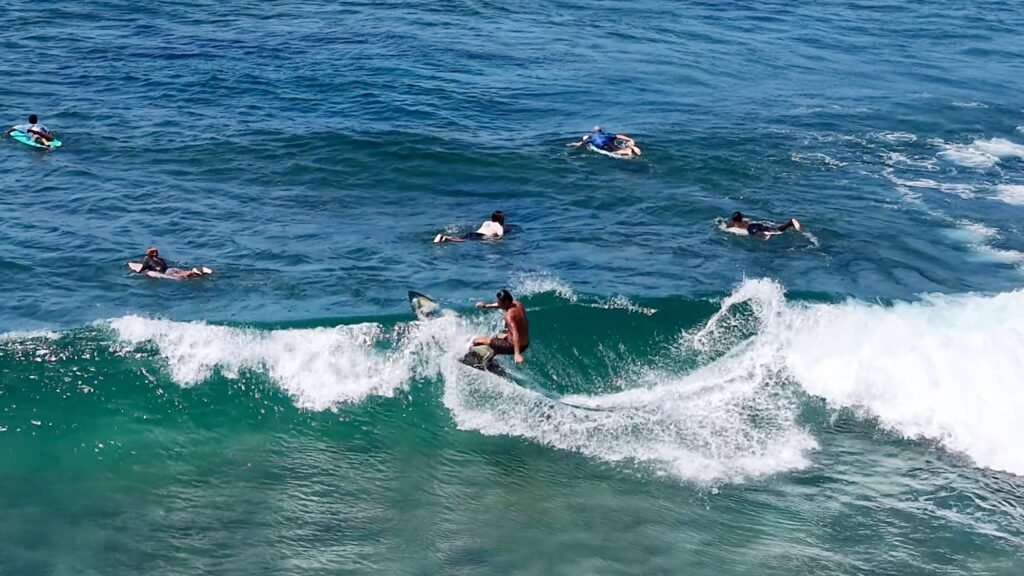
Hikkaduwa delivered everything we needed. Long beach walks, unexpectedly close encounters with sea turtles working the shallows, surfers drawing small crowds outside the beachfront cafes, extraordinary late-afternoon light that made the camera feel weightless in my hands. And perfect opportunities to fly my drone as close to the surf as I dared.
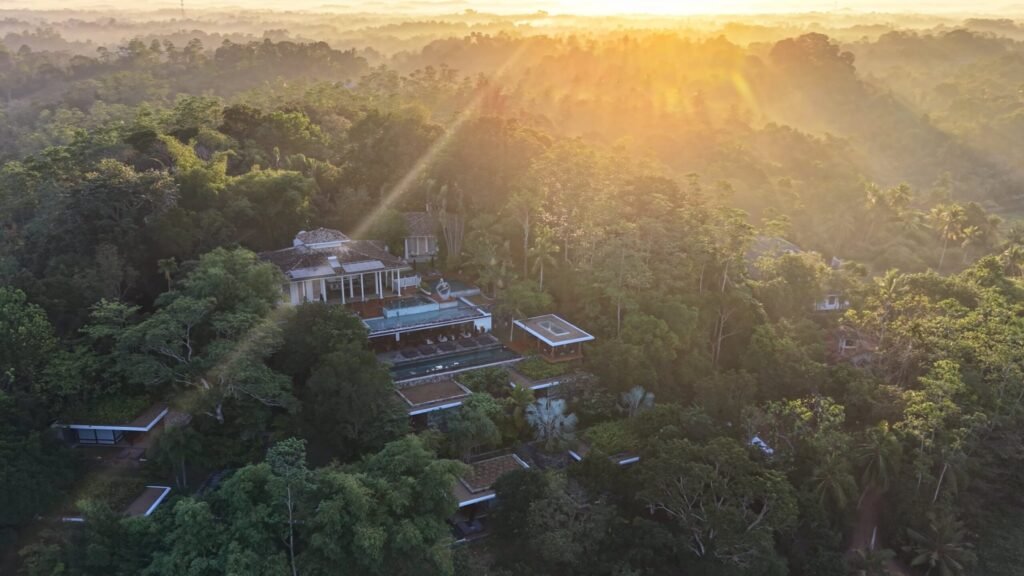
And then Haritha Villas + Spa — a boutique retreat on a hill above the Hikkaduwa countryside, booked on a whim as what I thought was a small indulgence.
It turned out to be one of the finest decisions of the entire trip.
Read our full review of that resort here.
The Morning That Made Sense of Everything
We woke before sunrise on our first morning at Haritha Villas, wrapped ourselves in light layers, and stepped out onto the terrace without speaking.
The air was already alive.
Peafowl calling from somewhere in the trees below. White-throated kingfishers cutting through the lower garden in flashes of electric blue. Yellow-billed babblers in animated conversation with each other. Greater coucals moving low through the undergrowth. White-browed bulbuls, red-vented bulbuls, black-hooded orioles: a layered, shifting, breathing chorus that no playlist could replicate, because no playlist has this geography, this particular light, this specific morning.
And then movement above us: a troop of purple-faced langur monkeys, drifting quietly through the canopy overhead, pausing to look down at us with the unhurried curiosity of creatures that have never needed to be anywhere quickly.
It lasted perhaps forty minutes. We didn’t move. We didn’t speak.
Reflection time
Mel & I had arrived in Sri Lanka thirty-four days earlier with an itinerary. We’d stayed for over fifty days because the world had other plans. Mel particularly had been anxious, exhausted, occasionally furious, and more than once genuinely uncertain about when or how we’d get home.
And now we sat on a hilltop terrace while the birds called the sun up, and a monkey watched us from the trees, and none of the rest of it mattered at all.
We’d been stranded in paradise.
Were you caught up in the Middle East flight disruptions? Or planning a trip to Sri Lanka and wondering how to navigate the unexpected? Drop your questions in the comments — we’ve learned more than we ever expected to about travelling through the unplanned.
And if you’re wondering how we book Business Class travel for a fraction of the price, our complete Avios and Companion Voucher guide is [right here] (https://hindlesworld.com/british-airways-avios-companion-voucher-guide/).
Frequently Asked Questions
Don’t leave the airport or offboard your luggage until you have confirmed alternative arrangements in place. Contact your airline’s customer service directly — and if you’re a frequent flyer card holder (BA Gold, for example), use the dedicated priority line rather than the general helpline. Simultaneously, activate any local contacts who might help with accommodation, and open Skyscanner to start mapping alternative routing options while you still have airport wifi.
This is where it gets murky. Under UK and EU261 regulations, airlines are obligated to provide care (meals, accommodation, rebooking) for cancellations within their control. Extraordinary circumstances [which airspace closures due to armed conflict typically qualify as] can limit their liability. In practice, what you actually receive depends heavily on which airline you’re dealing with and how firmly you advocate for yourself. Document everything, push back politely but persistently, and escalate to a supervisor if front-line staff are unhelpful.
Sri Lankan Airlines couldn’t wait to see us off their property!
Yes, in most cases. If your airline cancels the flight (rather than you choosing to cancel), you are generally entitled to a full refund or free rebooking on an alternative route at no extra charge. If you booked with Avios or airline miles, those should be reinstated. Keep records of all correspondence, and if rebooking happens verbally by phone, follow up immediately in writing to confirm what was agreed — as we discovered, what’s “confirmed” verbally can quietly disappear from the system.
The practical options, in rough order of availability and cost during the 2026 disruptions: via Mumbai or Delhi (India) connecting to European carriers; via Bangkok or Singapore connecting westward; via Istanbul on Turkish Airlines; via Kuala Lumpur or Tokyo for longer Pacific routings. Mumbai was our solution: Sri Lankan Airlines operates the Colombo–Mumbai route daily, with straightforward onward connections to London. India requires a visa for most nationalities, so apply immediately if this route appeals; don’t wait.
Apply online at indianvisaonline.gov.in as soon as possible: the process takes 2–5 days under normal conditions and longer during high-demand periods. You’ll need a passport scan and a separate passport-format photo uploaded as a JPG (strict size and dimension requirements apply). Use a desktop browser if at all possible as the mobile experience is genuinely painful. Claude.ai can help you resize photos and documents to meet the portal’s specifications. Crucially: complete the payment step immediately once you reach it. The portal will reject applications where payment isn’t completed promptly relative to the travel date.
Skyscanner’s flexible routing view is the most useful tool for scanning multiple options simultaneously. Google Flights works well for specific routes once you’ve identified a pathway. The key constraint with Avios bookings is that your replacement flight technically needs to be on a OneWorld partner — though during major disruptions British Airways has shown willingness to be pragmatic. Call the BA Gold line (or your equivalent tier line) rather than relying solely on chat for complex rebooking; a senior agent has authority that front-line chat handlers often don’t.
It depends entirely on your policy wording and when you purchased it. Policies bought after a conflict situation becomes “known” typically exclude it as a foreseeable event. Policies with “travel disruption” cover — as distinct from basic cancellation cover — are more likely to pay out for additional accommodation and alternative flights. Keep every receipt, document every decision with timestamps, and call your insurer early rather than late — they may have preferred booking channels that reduce your out-of-pocket costs.
Negombo is your best base — it’s 7km from the airport (a short PickMe ride), has a good range of accommodation, and avoids the noise and air quality issues closer to the city. We’d strongly recommend filtering for smaller, owner-run hotels rather than large chains: during a crisis, a human who cares makes an enormous difference. Agandau House on the Negombo beachfront became an unexpected community during our extended stay — the owner’s instinct to look after people, not just process bookings, was the difference between a stressful limbo and a genuinely memorable experience.
Accept the things you cannot control as early as you can — every hour spent checking Flightradar24 obsessively (and we speak from experience) is energy spent on something that changes nothing. Build a small routine: morning walk, one practical task per day (visa application, flight search, insurance call), and something enjoyable in the evening. Connect with fellow travellers in the same situation — the shared experience creates bonds surprisingly quickly. And if you’re near the Sri Lankan coast, let the ocean do its work. It is, as it turns out, very good at perspective.
In our case, unambiguously yes, though we wouldn’t have believed that on night one. The extended south coast stay gave us Hikkaduwa properly, a sunrise at Haritha Villas that neither of us will ever forget, and a slower, more honest experience of Sri Lanka than any itinerary could have engineered. The disruption forced us off the plan and into the actual country. If you find yourself stranded, give it 48 hours before concluding it’s a disaster. It might just be the best unplanned chapter of your trip.

💬 Share Your Thoughts
We love hearing from fellow travellers. Whether you have a question, a tip, or your own story to add, please jump in! We reply to every comment personally.