
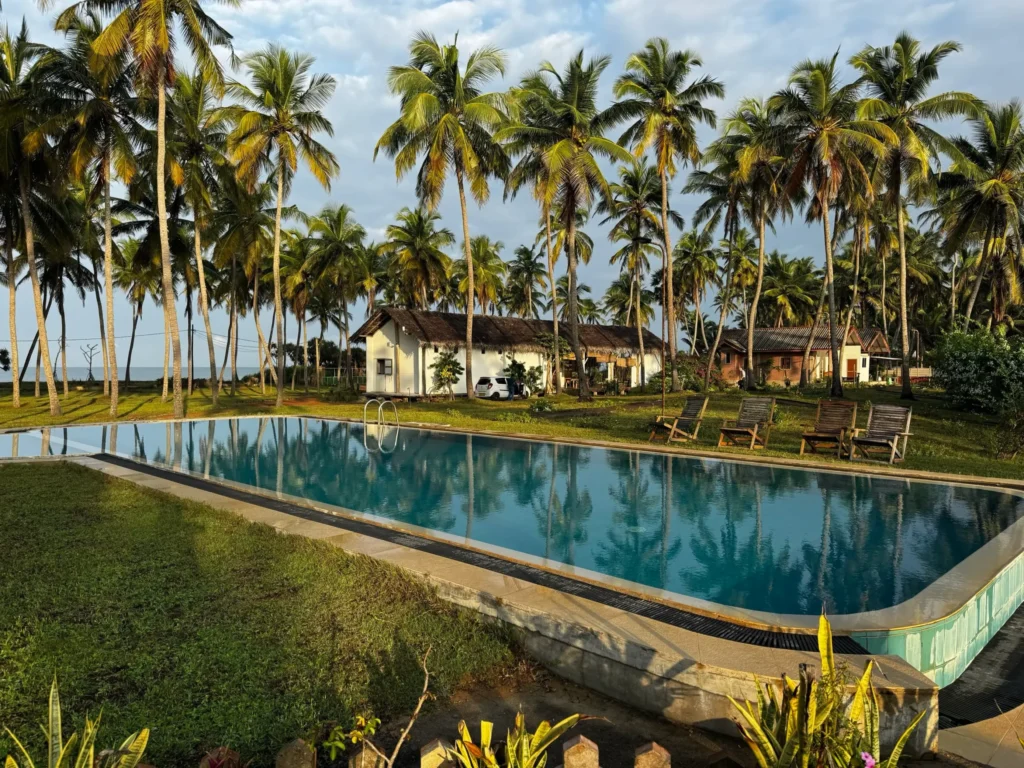
We didn’t book Twin Waters Resort in Chilaw because it was special. We booked it because it was close to the airport, reasonably priced, and sat beside a bird sanctuary we wanted to visit at dawn. A launchpad. A place to sleep off the flight and start the real trip in the morning.
We were wrong about that. But it took us a while to realise it.
Watch the full film here. Fair warning: the story the owner told us over dinner is something we promised to protect, and you’ll need to watch to understand why that promise became the film’s creative heart.
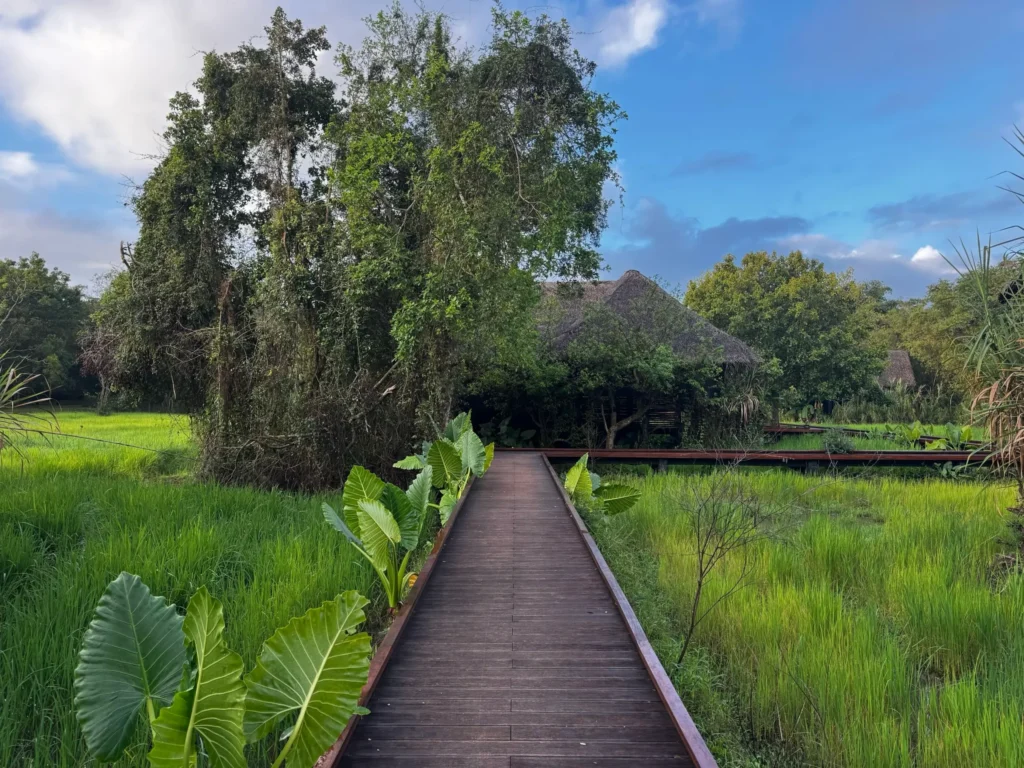
Ten days later, we checked into Jetwing Vil Uyana near Sigiriya: a property that costs roughly five times what Twin Waters charges. A man-made wetland ecosystem built from scratch around thatched villas in the paddy fields. Plunge pools. A personal butler. Brahminy kites circling overhead.
Two hotels. Two wildly different price points. The obvious story writes itself: cheap versus expensive, basic versus luxury, which one wins?
That’s not the story.
The story is that both places delivered something we hadn’t gone looking for. And in both cases, the thing that stayed with us cost nothing at all.
The Sand That Bit Our Legs
Our driver Shan collected us from Bandaranaike Airport and pointed the station wagon north along the coast. His English was functional but warm; enough to get us where we needed to be, occasionally supplemented by Google Translate and a lot of good-natured hand gestures.
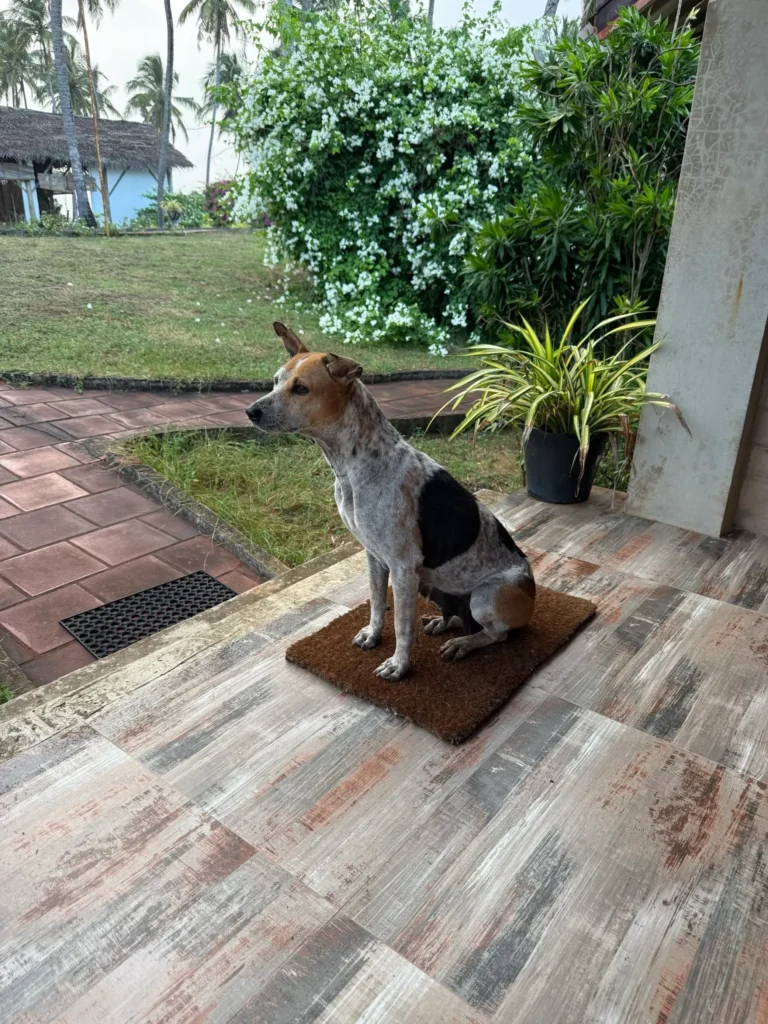
Twin Waters Resort sits between two bodies of water: the Indian Ocean on one side, the Anawilundawa wetland lagoon on the other. Coconut palms everywhere. The road in is local, unpaved for the last stretch, and the first thing that hits you is the sound. Not silence (Sri Lanka is never silent) but a layering of noise that your ears need a few minutes to separate. Waves crashing on the beach. The constant, overlapping calls of birds from the lagoon. A dog barking somewhere in the village.
We dropped our bags and walked straight to the beach. It was windier than we’d expected. Properly fierce, the kind of wind that whips the sand low against your shins until it feels like it’s biting. No swimming here. But the light was extraordinary, low and golden, and as the sun dropped, local fishermen were launching from the shore, silhouetted against the water.
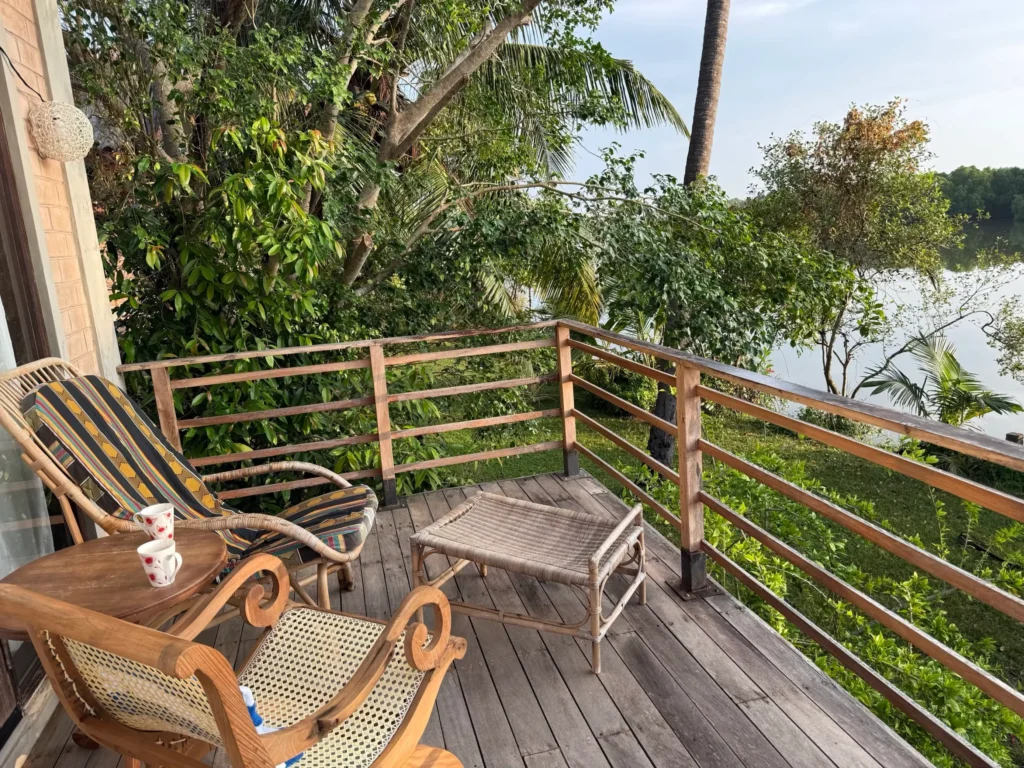
The room was simple. Clean, modern, air-conditioned, with a fridge and tea-and-coffee facilities. A balcony looked out toward the lagoon. It was perfectly adequate, which is all we’d expected. We’d ordered Sri Lankan prawn and chicken curries on arrival and spent our first evening trying to stay awake long enough to eat them.
We nearly didn’t manage it. Jet lag and the warm, salt-heavy air conspired against us. But the food, when it came, was home-cooked by the family who run the resort, and it was the first signal that something here was different from what we’d assumed.
What We Got Up For
I set an alarm for the dawn chorus and then, naturally, slept for about three minutes. Too hot. Too cold. The fridge too loud. I turned it off at 3am. The aircon went back on at 4:24am. The stuff of sleepless-night nightmares.
But the morning made up for it.
Twin Waters Resort sits within walking distance of Anawilundawa Wetlands, one of Sri Lanka’s important Ramsar sites: a network of ancient irrigation tanks that have become a sanctuary for resident and migratory birds. I walked out before the mist had lifted, opened the Merlin Bird ID app on my phone, and started recording. The Asian Koel was the one that got me: a rising, two-note call that carried right across the lagoon.
Filming birds, it turns out, is significantly harder than hearing them. I flew the drone carefully. There are huge expanses of water in front and behind the resort, and the Brahminy Kites that circle the area had me nervous. I’d lost my last drone to a Red Kite in France during the summer and wasn’t about to sacrifice another on day one.
After breakfast (papaya, mango, bananas, followed by omelette and toast, followed by Sri Lankan string hoppers with pol sambol: rice noodles with a coconut, chilli and onion relish that we’d come to crave for the rest of the trip), Shan arrived and said something we’d hear a lot over the next ten days: “Quick, grab your camera.”
A hundred yards from the resort, twenty-odd fishermen were hauling a massive trawler net back to shore. Two tractors anchoring the ropes. Men wrapping the net hand over hand to trap the smaller fish. The whole thing felt choreographed by generations of practice; every person knew exactly where to stand, when to pull, when to wait. We stood and watched, and nobody seemed to mind.
The Man Who Asked Us To Keep His Secret
That evening, the owner sat down with us after dinner.
We’d already noticed something about the way Twin Waters Resort operates. It’s not a hotel in the conventional sense. It’s a family home that happens to have guest chalets. The food is cooked by the family. The conversations happen naturally, not as a service. There’s no front desk performance, no rehearsed welcome. Just people who seem genuinely interested in who you are and where you’ve been.
What the owner told us that night (his story, his history, how the resort came to exist) changed the way we understood the place entirely. It also wasn’t ours to share. He asked for privacy. We gave it.
In the film, that request became the creative device. The decision to honour it shaped the entire edit. I won’t explain how here; that’s something you need to see rather than read. But I will say this: some stories are better protected than told, and the restraint made the film stronger than the reveal ever could have.
If you’ve watched the film, you’ll know what I mean. If you haven’t, this is why you should.
Chilaw and the 35kg Tuna
We visited Negombo Fish Market twice: once on arrival and once after a couple of days at Twin Waters. The first visit hit us with the smell before we’d opened the car door. Stalls of fish and prawns in various states of preparation. Tennis-court-sized areas of fish drying in the sun. At the beach, fishermen were untangling catch before hauling it up in tarpaulins.
Then the heavy mob. Men with massive, lethal machetes dispatching hundreds of kilos of fish. The skins dried for later use, the rest processed into fish paste. The sound and smell took us straight back to Battambang in Cambodia: that same raw, industrial energy where food production meets the sea.
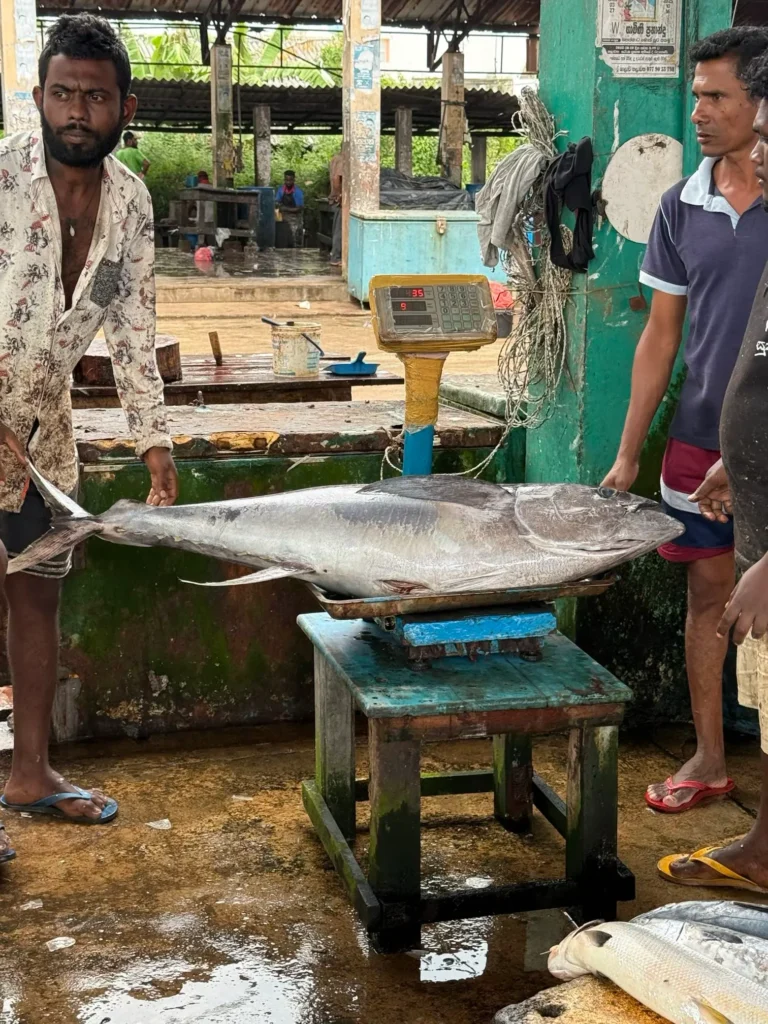
In Chilaw itself, we stopped at the fishery harbour to watch a 35kg tuna being weighed. The scales struggled with it. The men around it didn’t; they’d seen bigger. We also visited the Munneswaram Kovil, a Hindu temple where we watched locals receiving blessings. The temple was calm and orderly and deeply private in a way that felt generous to witness.
These are the moments that don’t appear in most Sri Lanka itineraries. Chilaw isn’t a tourist town. It doesn’t try to be anything other than what it is. And what it is (working, alive, unselfconscious) made every interaction feel earned rather than performed.
For anyone planning this route, the Sri Lanka Adventure Planning Guide covers the logistics of getting around the island with a private driver. It’s how we navigated pretty much everything.
Driving Up Country
We left Twin Waters Resort after two nights and headed inland toward Sigiriya, with a two-night safari detour at Wilpattu along the way. The drive took us through rice paddies and storm-damaged landscape, and the shift from coastal flat to interior green was gradual enough that you barely noticed it happening. Until suddenly the light was different and the air was cooler and the ocean was gone.
By the time we reached Sigiriya, we’d been on the road for over a week. Temple visits. Safari mornings. Long drives with Shan. We were ready to stop moving for a while.
Jetwing Vil Uyana was supposed to be that stop. Two nights of luxury. A chance to recharge.
What we found was something else.
Building Nature and Putting Beds in It
What the website doesn’t quite prepare you for about Jetwing Vil Uyana is this. You read “man-made wetland” and your brain files it alongside artificial lakes and landscaped gardens. Something constructed. Polished. Designed to look natural while being anything but.
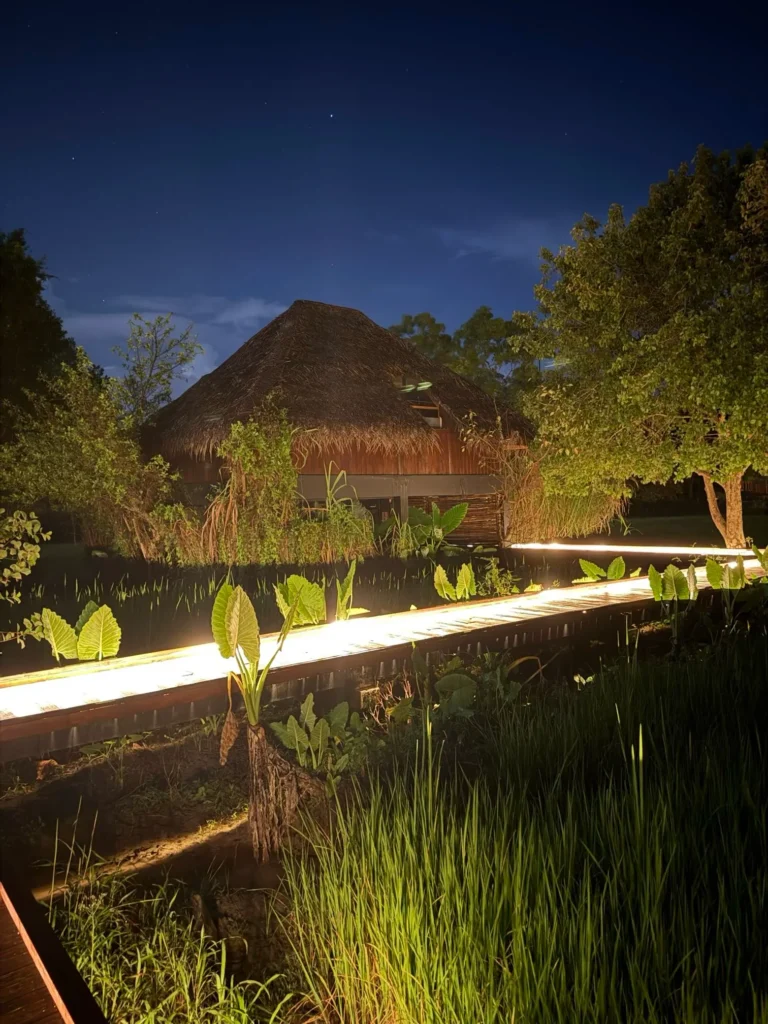
Jetwing Vil Uyana isn’t that. Someone (and I say this with genuine admiration) looked at the paddy fields near Sigiriya and said: what if we built an entire ecosystem from scratch and then put accommodation inside it? Not alongside it. Inside it. The villas don’t overlook nature. They’re submerged in it.
Our room rose above the paddy fields with a small plunge pool, a sun deck, and a coffee terrace that became my favourite place on the entire trip. It was hidden from every other villa, yet close to reception, the spa, and the gym. The privacy felt deliberate: not just architectural, but philosophical. As if the design was saying: you are here to be still. So be still.
The first morning, I woke at dawn and walked to the veranda. The paddy fields stretched out below, being prepared for the year’s first rice crop. Bird calls; quieter than Twin Waters but more varied, more layered. And despite the lakes and wetland on all sides, barely a mosquito in sight. I sat there for forty minutes doing nothing. On a trip built around movement and filming and chasing light, doing nothing felt almost radical.
Breakfast and the Bread Van
We had one rule at Vil Uyana: eat until you physically cannot eat any more, then eat one more thing.
The breakfasts were European-meets-Sri-Lankan in the best possible way. Mango smoothies. Bircher muesli. Eggs Benedict. A basket of bread and croissants. By our standards, this was colossal. By Vil Uyana’s standards, we later learned, we’d been restrained.
Suranga, our dedicated butler, arranged everything. Meals, housekeeping, anything we needed, all delivered with a calm warmth that never once felt like service and always felt like care. The new manager, Mr Punchihewa, stopped by with complimentary drinks and a conversation about the property’s approach to conservation. He’d come from Jetwing Surf & Safari (a property we’d visit later on our tour) and his enthusiasm for the wetland ecology was infectious.
One morning, I walked outside the property to fly the drone, far enough from the villas that the buzz wouldn’t disturb anyone. Vil Uyana is that kind of quiet. You feel guilty about noise.
I was setting up when I heard it. Tinny, electronic, blaring across the paddy fields with zero concern for anybody’s peace: “It’s a Small World.” The Disney classic. At full volume. From a loudspeaker strapped to a green three-wheeled van stacked floor to ceiling with fresh bread.
The Choon Pan: Sri Lanka’s mobile bakery. Tuk-tuks converted into glass-fronted display cabinets, loaded with loaves and buns and pastries, circling villages from before dawn. Most play Beethoven’s Für Elise, but ours had gone rogue with Disney. I’d left the hotel to avoid disturbing people with my drone. The bread van had no such concerns.
It’s a small detail. But it’s the one that stuck. Not the plunge pool. Not the paddy fields. A bread van on a red dirt track, playing Disney at sunrise, while I stood there with a drone I was too polite to launch.
The Girl from Clapham
On our second day, we agreed to meet Shan for a quick tour of Sigiriya. The rock fortress is ten minutes from the hotel, and while we’d planned to fly the drone for aerial footage, we stopped at a café on the approach road first.
Just as I was about to take off, two girls walked over to watch. Extra pressure. One of them spoke in a very particular kind of English: the accent you develop when you grow up somewhere specific and carry it everywhere.
“Where are you from?” I asked.
“London.”
“Clapham?”
She looked mortified. “Yes! How did you know?”
My son Jack lives there. Small world, smaller when you’re 5,000 miles from home.
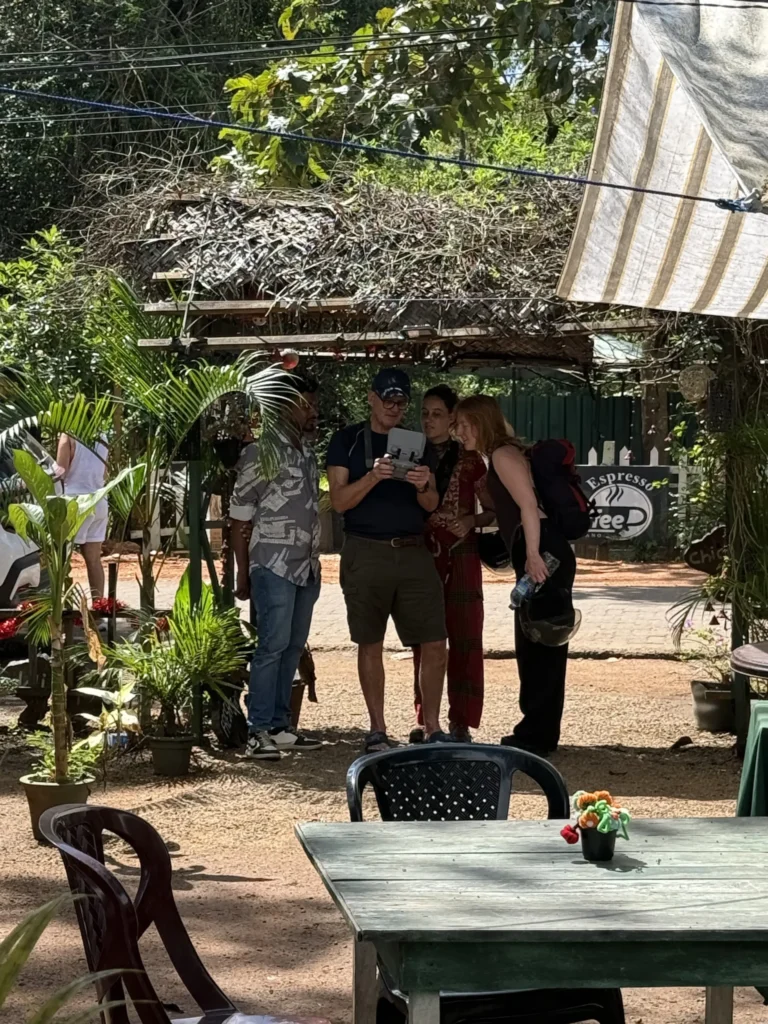
At that point my drone was heading around the back of Lion Rock. I’d maxed out at 120 metres and couldn’t go higher. Then the words every drone pilot dreads: “Lost signal. Your drone is no longer connected.” Emergency return-to-base. Panic. Relief. Some decent images, somehow.
For anyone planning to visit: consider Pidurangala Rock instead of Lion Rock. It’s around $3 compared to $30, the views are comparable, and the crowds are a fraction of the size. If you do climb Lion Rock, the gates open at 5:30am. Be first in the queue, before the heat and the tour groups arrive. The Sri Lanka travel documentary companion post has more on the Cultural Triangle itinerary.
The Millipede Incident
One detail Mel would want me to include (and would probably murder me for including) involves our final night at Vil Uyana.
She turned back her pillow to find a millipede. Not a small one. The kind that makes you wonder exactly how long it had been there. Had it been there all night? While she slept? On her pillow?
These are the questions that do not have comfortable answers. Especially when you’re staying in a villa literally built inside a wetland ecosystem. Nature doesn’t observe the boundaries between “resort” and “wild.” The millipede was simply living where it lived. Mel, to her credit, dealt with it with more composure than I would have managed.
It’s a small thing. But it captures something true about Vil Uyana. The beauty isn’t sanitised. The wildlife isn’t curated for your comfort. You’re in it. That’s the point.
The Man Who Built It
After the film went live, a comment appeared beneath it that stopped me.
A Sri Lankan man, working in Dubai, wrote to say that his father was the person who created the wetland and paddy fields at Vil Uyana. He’d accompanied his father on the initial site visit with Jetwing owner Hiran Cooray and architect Sunela Jayawardena. Back then, in 2003 or thereabouts, it was bare land. His father designed it all: the wetland ecosystem, the coffee tables in the villas, some of the furniture. His name is Piyasoma Bentota. He’s now 81 years old.
I’d written earlier in this post that “someone looked at the paddy fields and said: what if we built an entire ecosystem from scratch?” Now that someone has a name. And his son, watching our film from the other side of the Indian Ocean, recognised his father’s life’s work in what we’d captured.
A girl from Clapham at a café in Sigiriya. A bread van playing “It’s a Small World” at sunrise. A man in Dubai watching a film and seeing his father’s legacy. Sri Lanka kept telling us the same thing, and we kept not quite hearing it until later: the world is smaller than you think, and connection finds you whether you’re looking for it or not.
What We Actually Learned
We thought this was a comparison. Cheap hotel, expensive hotel, which one wins.
It isn’t a competition. It’s a question: what does peace actually cost?
Twin Waters Resort, Chilaw, costs around $99 a night. You get a clean room, home-cooked food, an owner who sits with you after dinner and tells you something that changes how you see the place. You get fishermen hauling nets at dawn, and a bird sanctuary that most tourists drive past on their way to Sigiriya. You get a family who made something from what they had, and a story that, even now, we’ve promised to keep.
At Jetwing Vil Uyana Sigiriya, it costs roughly $300–500 a night depending on the season. You get an ecosystem. A plunge pool above the paddy fields. Silence that feels engineered by the landscape itself. A butler who remembers how you take your tea. And a millipede on your pillow, because nature doesn’t negotiate.
Both places are isolated. Both require a driver. Neither has a town you can walk to for dinner. At Twin Waters, the beach is beautiful but too rough for swimming. At Vil Uyana, there’s nothing beyond the property except a village track and the paddy fields.
And both gave us something we didn’t book. At Twin Waters, it was a conversation that we’ll carry for years. At Vil Uyana, it was the realisation that you can build nature from nothing and it will become real. That someone’s vision, executed with enough care and enough patience, can create a place that doesn’t feel made at all.
You don’t need to spend a fortune to find peace in Sri Lanka. But if you have the fortune to spend, Vil Uyana is where you should spend it.
This post is part of the Been & Scene editorial series: companion stories to the HindlesWorld films. For the full 54-day Sri Lanka journey, start with Was Sri Lanka Worth It?
Planning Your Visit: Twin Waters Resort, Chilaw
If you plan on visiting the area, we’ve created a few FAQ’s that might help you.
Twin Waters is roughly 75km north of Bandaranaike International Airport (about a ninety-minute drive depending on traffic). We arranged a private driver for our entire Sri Lanka trip, which is the most practical option for this part of the coast. The resort offers free private parking, and the final stretch of road is local and unpaved but manageable. There’s no reliable public transport to the resort itself, so a driver or arranged transfer is essential.
Anawilundawa is a Ramsar-designated wetland sanctuary: a network of ancient irrigation tanks that support a significant population of resident and migratory birds. It’s less than 2km from Twin Waters and is worth visiting if you have any interest in birdwatching, even casually. The best time is first light, when the bird activity peaks. Bring the Merlin Bird ID app (it’s free and transforms the experience). The best months to visit Chilaw and the wetlands are October to April, with March potentially ideal as water levels drop and birdlife concentrates.
All meals are home-cooked by the family. Expect Sri Lankan dishes: curries, string hoppers with pol sambol, fresh fruit, alongside simpler options like omelettes and toast. The coconut sambol became our favourite dish of the entire Sri Lanka trip. You can also ask Shan-style drivers to take you to Chilaw for additional dining options, though the home cooking is honestly hard to beat.
That depends entirely on what you’re looking for. As a destination in its own right (somewhere to stay for two or more nights, decompress, and absorb the setting) it’s exceptional. The wetland ecosystem, the villa design, the food, the service all justify the premium. But if you’re using it purely as a base for Sigiriya sightseeing and will spend most of your time off-property, the value equation shifts. Stay somewhere more affordable and visit the Cultural Triangle sites. Come to Vil Uyana when you want to stop moving.
Pidurangala. It costs around $3 compared to $30 for Lion Rock, the views are arguably better (you can see Lion Rock itself from the summit), and the crowds are significantly smaller. If you’re set on Lion Rock, arrive when the gates open at 5:30am. The early morning light is better, the heat is manageable, and you’ll have a head start on the tour groups. January to March offers the best weather for the Sigiriya area.
Yes. Both Twin Waters and Jetwing Vil Uyana are isolated from towns, restaurants, and public transport. A private driver is essential for getting to either property, for day trips (Negombo Fish Market, Chilaw, Munneswaram Temple, Sigiriya), and for moving between destinations. Our driver Shan was with us for ten days and became an integral part of the trip: part guide, part fixer, part friend.
Related HindlesWorld content:
- Was Sri Lanka Worth It? The Hub Film: the full 54-day Sri Lanka story
- Sri Lanka Adventure Planning Guide: logistics, drivers, routes, and itinerary planning
- Sri Lanka Travel Documentary: the companion post to the main series
- Stranded in Paradise: what happened when our plans fell apart
- Haritha Villas & Spa, Hikkaduwa: another Sri Lanka accommodation review
- TripWorthIt™: our persona-specific hotel evaluation tool
- We Came For The Tea Train | But That’s Not The Story: Our voyage on the iconic blue train to Ella.

💬 Share Your Thoughts
We love hearing from fellow travellers. Whether you have a question, a tip, or your own story to add, please jump in! We reply to every comment personally.