
Beyond The Postcard
Tea country, wild encounters and places worth slowing down for — a practical guide from our 54-day journey.
We came to Sri Lanka with a carefully worked-out plan. We left with a rather different story.
Plan your journey: Template Routes · Logistics & Prep · Transport Strategy · TripWorthIt™ Hotel Scores · The Films · When To Go
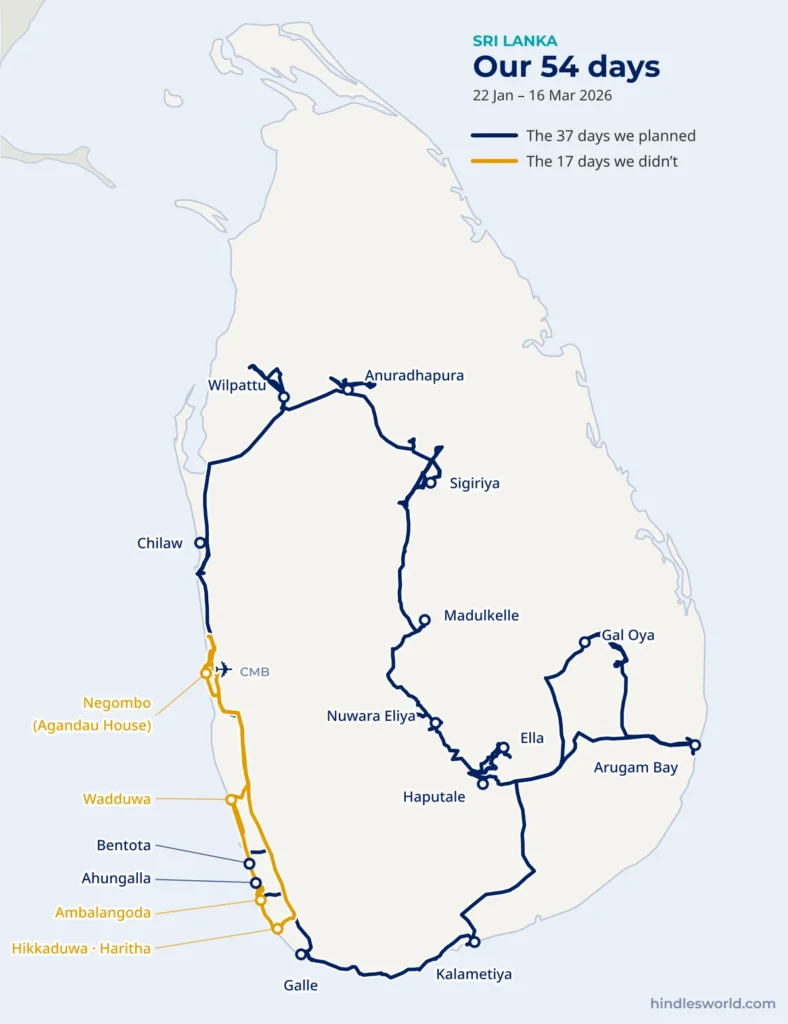
Between leaving home on 22 January and returning on 16 March 2026, we explored ancient cities, travelled through tea country, searched for leopards and discovered small hotels that changed how we want to travel. Flight cancellations extended our journey, opening the door to places we had never planned to visit.

This guide turns that experience into something you can use: manageable routes, practical transport advice, honest hotel scores and films that show what the journey actually felt like.
You don’t need 54 days. You need to decide which parts belong in your trip.

We Came For The Tea Train | That Wasn’t The Story!

Two Sri Lankan Hotels. One cost 5 times the other. But that’s not the story.

Sri Lanka Changed Our Minds About Almost Everything

Sri Lanka Adventure Itinerary

Stranded in Paradise: How the Middle East Crisis Kept Us in Sri Lanka

Haritha Villas + Spa Review – Is this Hikkaduwa’s Best Boutique Resort?
When To Go
Sri Lanka is a genuine year-round destination, but only if you know exactly which side of the island to be on.
The country is split by two alternating monsoon seasons, meaning the “best” time to go depends entirely on your route.
From December to April, the South and West coasts and the Hill Country are at their dry, sunny peak. However, this same window is the dead season for the East coast. We found Arugam Bay to be an absolute ghost town in February because that entire coastline essentially boards up its shutters until late spring.
(As a quick heads-up if you were thinking of swapping it for Trincomalee: heading north wouldn’t save those February beach days! Trincomalee sits on that same eastern coastline and catches the same Maha winter monsoon, which brings heavy rain from November through January).
To see the East coast beaches at their bustling best, you need to time your visit between April and September: right when the South and West coasts are getting drenched by their own summer monsoon.
Finally, if you are heading down to the southeast corner for a safari, bear in mind that while it has its own microclimate, it still takes a soaking from that northeast monsoon during the winter months.
Make It Happen: Your Sri Lanka Itinerary
Our journey is inspiration, not a route you need to copy hotel by hotel. These two templates bring together the experiences we would build a holiday around, with enough time to enjoy where you are staying.
Count days on the ground: the routes below allow 13 or 20 hotel nights. International flights may require an additional travel day. A late arrival is a good reason to spend your first night near the airport and adjust the route.
Choose your coast for your dates. These routes finish on the south or southwest coast, generally a stronger fit for a northern-hemisphere winter holiday. The east coast has a different seasonal pattern; adding Arugam Bay should be a deliberate seasonal choice, not another pin squeezed into the same trip. Check Sri Lanka Tourism’s seasonal guidance.
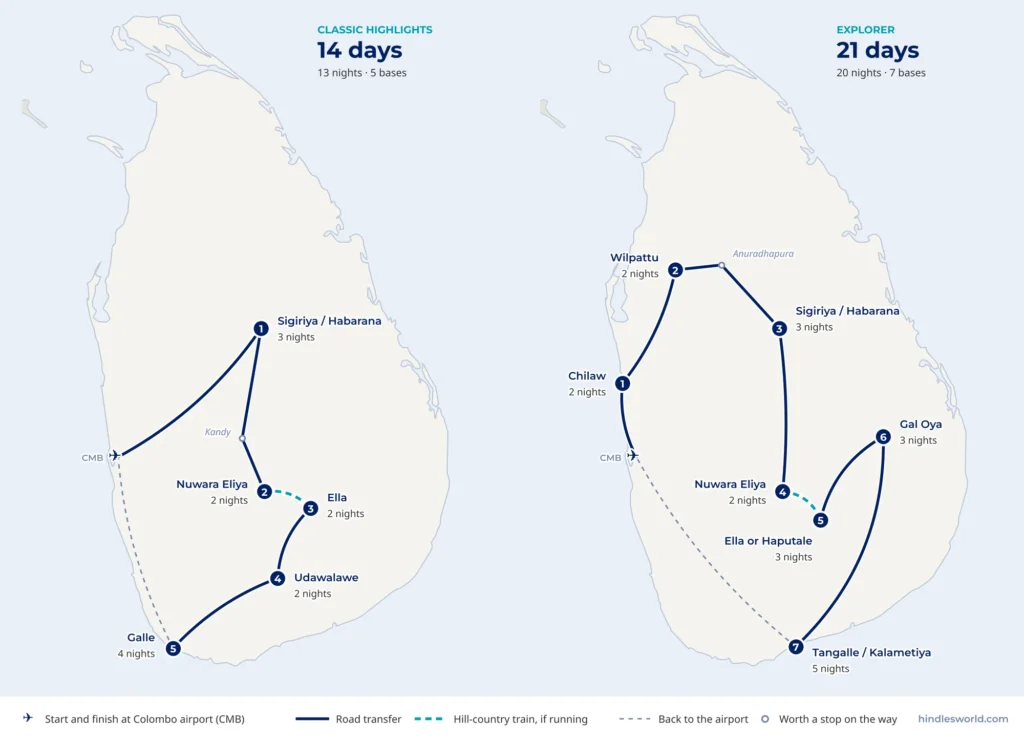
14-Day Classic Highlights
Best for: a first visit combining ancient sites, tea country, a scenic train journey, wildlife and time by the sea.
13 nights · 5 bases · private transfers, with an optional train segment
Days 1–3: Settle into the Cultural Triangle: 3 nights
Choose one base around Sigiriya, Dambulla or Habarana. If your flight arrives early and you feel up to it, arrange a direct transfer from the airport; otherwise, give yourself an arrival night nearer CMB.
Allow one morning for Pidurangala or Sigiriya, another for Dambulla’s cave temples, and leave space for the pool. If an elephant safari appeals, ask which nearby park currently offers the most suitable conditions rather than choosing solely by a familiar name.
Pidurangala gives you the view of Sigiriya’s rock fortress. Climbing Sigiriya gives you the experience of the fortress itself. They answer different questions, so choose the one that interests you most.
Days 4–5: Tea country around Nuwara Eliya: 2 nights
Travel into the hills, allowing the transfer to occupy much of the day. A stop around Kandy can break the journey, but don’t turn it into an ambitious sightseeing list as well.
Spend your full day exploring a tea estate, taking a factory tour and enjoying the change of climate. We found Pedro a useful introduction to what happens between a green hillside and a cup of tea. Bring a layer for the cooler evenings.
A stay around Madulkelle is an alternative if the estate setting is your priority, but it changes the following transfer: Madulkelle and Nuwara Eliya are not interchangeable station bases.
Days 6–7: Ella and the railway: 2 nights
If services are operating, arrange a train from Nanu Oya towards Ella and agree a separate luggage transfer with your driver. Keep a road alternative: our own railway plans changed because of storm damage.
Use your full day for a manageable combination of Little Adam’s Peak, the Nine Arch Bridge and time in town. You don’t need to complete every viewpoint. The bridge is beyond Ella station when travelling from Nanu Oya, so that train journey does not automatically take you across it.
Ella suits travellers who enjoy a lively town and plenty of cafés. If you want quieter evenings and tea-country scenery, consider Haputale instead and reshape the local outings around it.
Days 8–9: Make room for wildlife: 2 nights
For this compact route, Udawalawe is a practical elephant-focused option between the hills and the south coast. Yala is an alternative if leopard habitat is a particular draw, with the understanding that sightings are never guaranteed and popular areas can be busy.
We did not visit either park on this trip. Our first-hand safari experiences were at Wilpattu and Gal Oya, included in the longer route below. Udawalawe is included here as a suggested route alternative, not a personal review. We didn’t go there, but actually wished we had as we weren’t that far away.
Two nights give you time to arrive, take a safari and leave without making every day a transfer day. Choose the guide and operator carefully, and ask how they handle crowded sightings and animal welfare.
Days 10–13: Finish by the sea: 4 nights
Choose one coastal base. Staying near Galle makes the fort easier to explore; Ahungalla or Bentota may suit a quieter resort finish. Pick the place that matches the holiday you want, rather than moving every night to sample another beach.
End your touring-driver arrangement here if you no longer need it. Use local transfers for outings and book your airport journey separately.
Day 14: Travel home
Allow a generous airport-transfer buffer. If your flight is early, move the final night closer to CMB rather than relying on a long pre-dawn journey from the coast.
21-Day Explorer: More Time, Fewer Compromises
Best for: travellers drawn to the quieter experiences that shaped our own trip, with time for both Wilpattu and Gal Oya.
20 nights · 7 bases · several substantial transfer days
This is a more spacious touring route, rather than three weeks of staying put. For genuinely slow travel, remove one safari stop and give those nights to the hills or coast.
Days 1–2: Ease in around Chilaw: 2 nights
Begin north of the airport, with time to recover and adjust to the heat. Our stay at Twin Waters introduced us to a more personal side of Sri Lankan hospitality before the touring began.
Negombo is the simpler alternative for a late arrival. You don’t need to stay in both places.
Days 3–4: Wilpattu: 2 nights
Continue north for your first safari stay. We came hoping for leopards, but wildlife doesn’t follow an itinerary. Choose Wilpattu for the whole experience of being in the park, not a promised photograph.
Quieter does not mean empty: we encountered a substantial entry queue ourselves. Discuss timings, likely driving hours and what is included with your camp before booking.
Days 5–7: Ancient cities and the Cultural Triangle: 3 nights
Anuradhapura can be a planned stop on the journey towards your Sigiriya or Habarana base, although a proper exploration deserves more time than a quick detour. If it is a priority, redistribute a night rather than squeezing it between long drives.
Use the remaining days for Dambulla and your choice of rock climb. Keep an afternoon free to enjoy the hotel: this is precisely where a good base can become part of the pleasure of the trip.
Days 8–9: Nuwara Eliya and tea country: 2 nights
Head into the hills, then give yourself a full day for tea, walking and cooler air. The journey is part of the experience; an estate visit is more rewarding when you aren’t watching the clock for another departure.
Days 10–12: Ella or Haputale: 3 nights
Take an operating section of the hill-country railway if it fits your dates, then settle into one base.
Choose Ella for cafés and easy access to its well-known viewpoints. Choose Haputale for a quieter tea-country focus, including an outing towards Lipton’s Seat. Check how far your accommodation actually is from town: a remote lodge can be wonderful, but it changes your transport needs.
Our tea-country experience included access arranged through personal connections. Don’t assume every private visit shown in the film is a tour you can book off the shelf.
Days 13–15: Gal Oya: 3 nights
Head east for a different kind of wildlife experience. The lake and boat safari are the reason to make this detour: a change of pace and perspective from a jeep safari.
Swimming elephants are a possibility, not an appointment. Ask about water levels, weather, activity availability and what your lodge package includes.
Gal Oya earns its place here because there is time to stay. We would not squeeze it into the two-week route as a casual substitute for a southern park.
Days 16–20: A proper coastal finish: 5 nights
Allow a substantial travel day from Gal Oya to the south coast, then stop moving.
Choose Tangalle or the Kalametiya area if a quieter coastal stay is the priority, or stay nearer Galle if the fort, restaurants and shorter local outings matter more. Five nights in one good base can be more satisfying than five beaches viewed through a car window.
If you want both, split this block between two bases and accept the extra packing day. Avoid adding Mirissa simply because it appears on every itinerary.
Day 21: Departure
Arrange your final transfer around the flight time. As with the shorter route, an early departure may justify moving the last night closer to the airport.
Want the planning detail behind these choices? Read our Sri Lanka adventure planning guide.
What We Skipped. And Why!
The climb up Sigiriya. Jez climbed Pidurangala for the view of Lion’s Rock. That was our choice, not a verdict that Sigiriya isn’t worth visiting. Pidurangala’s final section involves scrambling over rocks, so it isn’t an easy-access alternative.
Yala National Park. We chose Wilpattu and Gal Oya because their settings and experiences appealed to us more. That doesn’t make sightings more certain, or every safari quieter. We can’t offer a first-hand Yala review because we didn’t go.
Self-driving. After driving ourselves around Costa Rica, we chose a different approach here. Having a driver let us enjoy the landscape without negotiating unfamiliar traffic and overtakes. For us, that was money well spent.
Trying to fit in everything. These templates leave out places deliberately. The test isn’t how many names you recognise on the map. It’s whether you have enough time to enjoy being there.
Before You Go: The Crucial Logistics
Visas: apply through the official route
Check the requirements for your passport and apply through the official Sri Lankan ETA website before travelling. British passport holders should also check the FCDO entry guidance, including the requirement for six months’ passport validity on arrival.
If your stay will exceed the permission granted, arrange an extension through the official immigration service. A cancelled flight isn’t a reason to assume your permission extends automatically. Our unexpected extra days made this a very practical consideration.
Money: have rupees as well as cards
Sri Lanka’s currency is the Sri Lankan rupee (LKR). Keep cash for small purchases, tips and local journeys, and ask smaller properties how they want to be paid before arriving.
ATMs are available in major towns, but international-card acceptance varies. Carry a backup card, check withdrawal charges and replenish cash before remote stays rather than waiting until you have run out. Official travel and money guidance.
Drones: plan permission before the photograph
Bringing a drone into the country and receiving permission to fly it are separate matters. Start with the Civil Aviation Authority’s drone guidance, check the zone map, and use the flight approval portal. I followed the rules to the letter, but then ended up being caught out as we visited Mihintale (unplanned) and couldn’t fly as I didn’t have paperwork that specified that location (mine just said Anuradhapura area).
Do not assume a small drone, an empty beach or a hotel owner’s agreement gives you permission to fly. Archaeological sites and wildlife sanctuaries require additional authorisation from the relevant authority. Build your filming plans around the permissions you receive. Official additional-permission guidance.
Two small preparations that make a difference: arrange mobile data for navigation and driver contact, and keep offline copies of bookings and travel documents. Before departure, check current travel advice and your insurance cover.
Note: Visa, ETA and drone rules change – make sure you check before you travel. We last checked Nov 2026.
The Transport Playbook
The best transport plan changes as the trip changes. A driver can be invaluable while you are touring and unnecessary once you are spending your days at a safari lodge or beside the sea.
Option 1: A private driver for the touring days
Where it works well: airport arrivals, changing hotels, rural accommodation and days when you want several flexible stops. It also means you can look out of the window instead of concentrating on the traffic.
What to agree: the route, vehicle, luggage space, daily mileage, driver accommodation and meals, parking, tolls, overtime and any final return charge. Ask for the total arrangement in writing, not just a headline daily rate.
The hidden cost: you may still be paying for the car and driver while a lodge supplies your safari vehicle, or while you spend three days doing very little at the beach.
Our advice is to price the trip in stages. Compare a continuous hire with touring days plus individual transfers. There may still be a good reason to retain the same driver, but make it a conscious decision.
Agree sightseeing stops too. A spice garden or shop shouldn’t become a compulsory diversion simply because it sits beside your route.
Option 2: Driver + train, with a clear handoff
You don’t need to choose between the railway and the convenience of a driver. Combine them for a section of the journey:
- Confirm the operating route. Choose the railway segment first, checking current services with Sri Lanka Railways and your accommodation. Storm damage changed our own plans; a famous route on a map is not a guarantee of a through service.
- Secure the ticket and identify the exact station. Confirm the train, departure time and pickup station in writing with your driver. Nanu Oya serves Nuwara Eliya, but allow time to reach it from your hotel.
- Agree the luggage arrangement. If your driver is taking the main bags by road, explicitly agree the cost, destination and responsibility for them. Carry passports, valuables, medication and essentials yourself.
- Make the meeting point specific. Share the train details and agree whether you will meet outside the arrival station or at the next hotel. Keep a working phone connection and a fallback contact.
- Keep the road option available. If services are disrupted, don’t let one railway segment unravel the holiday. Travel by road and look for another operating section if the train experience matters to you.
Once you reach the coast: finish the touring hire if it no longer serves a purpose. Arrange local journeys as needed, and book the airport transfer in advance.
Where to Stay: Our TripWorthIt™ Scores
Our Top Pick: Haritha Villas & Spa
4.49/5 · Superb · Beat its price bracket · Yes, we’d pay the same again
Our highest-scoring Sri Lanka stay: a private villa retreat above Hikkaduwa where the service, food and space to switch off made the splurge feel worthwhile.
Read our full Haritha Villas & Spa review.
How We Score: The TripWorthIt™ System
A hotel can earn glowing reviews and still be the wrong choice for your trip. After reviewing 100 of our own stays, we built TripWorthIt™ to separate two questions: 1) how good was it? and 2) was it worth what we paid?
We each score every stay independently, then average our assessments across five pillars:
- Location & Access: How easy it is to arrive and reach what you came for.
- Service & Ease: How smoothly the stay actually runs.
- Hotel Offer: The food, the drink and the extras.
- Rest & Recharge: How well you sleep and switch off.
- Property & Setting: The grounds, pools and surroundings.
The pillar scores stay the same. Their weighting changes depending on the hotel’s job: a base for exploring or a destination for relaxing. That produces the TripWorthIt™ score out of five shown below.
Our separate value verdict compares the equally weighted average of those pillars with the quality our own hotel records suggest we should expect at that price. A stay can fall short, be about right or beat its price bracket. This is an experience-based benchmark drawn from our stays, not a verdict on the entire market.
And would we pay the same again? That remains a personal judgement. Even a wonderful, good-value stay can be worth doing only once.
Read what we learned from scoring 100 hotel stays →
The stays, the scores and our personal verdicts
These are the hotels we stayed in, not a list assembled from booking-site ratings. Base and Destination describe the job each hotel did on our trip. Nights are those recorded in our scoring workbook; scores are rounded to two decimal places.
The final column is our recorded personal rebooking answer, separate from the model’s predictions. “Only if cheaper” is a judgement about paying again, not automatically a poor value verdict.
| Stays (sorted alphabetically) | Nights | What Role did we want from the hotel | TripWorthIt /5 | Value verdict | Pay the same again? |
|---|---|---|---|---|---|
| Agandau House | 7 | Base | 3.62 | Beat its bracket | Yes |
| Ahu Bay | 2 | Destination | 4.12 | Beat its bracket | Yes |
| Aryana Boutique Hotel | 2 | Base | 2.86 | About right | No |
| At Kelly’s Ambalangoda | 1 | Base | 2.93 | About right | No |
| Cinnamon Lodge Habarana | 2 | Base | 3.57 | Beat its bracket | Yes |
| Gal Oya Lodge | 3 | Destination | 3.81 | About right | Only if cheaper |
| Haritha Villas & Spa | 2 | Destination | 4.49 | Beat its bracket | Yes |
| Jetwing Blue | 1 | Base | 2.62 | Fell short | No |
| Jetwing Saman Villas | 3 | Destination | 3.65 | About right | Only if cheaper |
| Jetwing Surf & Safari | 2 | Destination | 3.17 | About right | Yes |
| Jetwing Vil Uyana | 2 | Destination | 4.15 | Beat its bracket | Yes |
| Leopard Trails Wilpattu | 2 | Destination | 3.43 | Fell short | Only if cheaper |
| Madulkelle Tea & Eco Lodge | 2 | Destination | 3.50 | About right | Yes |
| Ravana Heights | 3 | Base | 3.22 | About right | Only if cheaper |
| Suite Lanka | 2 | Base | 3.09 | About right | No |
| Taru Villas Rampart Street | 2 | Base | 4.31 | Beat its bracket | Only if cheaper |
| The Fort Printers | 1 | Base | 3.63 | About right | Only if cheaper |
| The Grand Hotel – Heritage Grand | 2 | Base | 3.02 | Fell short | Only if cheaper |
| The Villa by Contemporary Ceylon | 2 | Destination | 3.34 | About right | Yes |
| Tropical House Jungleside Villa | 1 | Base | 3.79 | Beat its bracket | Yes |
| Twin Waters Resort | 2 | Base | 3.16 | About right | Yes |
| Villa Blu | 3 | Destination | 3.45 | About right | Yes |
| Villa Vista Haputale | 3 | Destination | 3.52 | About right | Yes |
How to use this table: start with the part of the island and the kind of stay you need, then compare the score, value verdict and our willingness to pay again. A high score doesn’t make a hotel the right choice for every itinerary.
For two particularly memorable and very different stays, read about Twin Waters and Jetwing Vil Uyana.
The Journey on Film
The guides help you plan. The films show what it felt like to be there: the anticipation, the disrupted plans, the people who helped and the moments no itinerary could have promised.
These are the journeys behind the postcard views.
 Was Sri Lanka Worth It? 54 Days, One Cyclone & The Itinerary Nobody Talks About (opens YouTube in a new tab)
 Stranded in Sri Lanka (opens YouTube in a new tab)
 He Asked Us To Keep His Secret (opens YouTube in a new tab)
 We Planned 37 Days in Sri Lanka. We Stayed 54 (opens YouTube in a new tab)
 Kandy to Ella: More Than Just A Train Ride (opens YouTube in a new tab)
Sri Lanka: Was It Worth It?
The wider journey, from ancient sites and tea country to wildlife and the coast. Start here for the shape of the adventure and the choices that helped define it.
Watch our Sri Lanka travel documentary.
Stranded in Sri Lanka: 17 Extra Days
We expected to be heading home. Instead, cancelled flights led to an unplanned chapter of small hotels, unexpected kindness and a different relationship with Sri Lanka. The part we hadn’t planned became a story of its own.
We Came for the Tea Train
The famous railway was the starting point. Damaged lines and changed plans took us deeper into tea country, and towards the people and work behind its beautiful hillsides.
Two Sri Lanka Hotels We Can’t Forget
Twin Waters and Jetwing Vil Uyana gave us two very different versions of a memorable stay. The film explores what happens when a hotel becomes part of the story, rather than simply somewhere to sleep. The story tells a little more.
Which part would you make your own: tea country, wildlife, or a small hotel by the sea?
▶ Subscribe to Beyond The Postcard on YouTube or scan the QR code below.