
We got three quotes. Then we took the biggest leap we’d ever made as independent travellers.
Travel Smarter · Been & Scene · Costa Rica
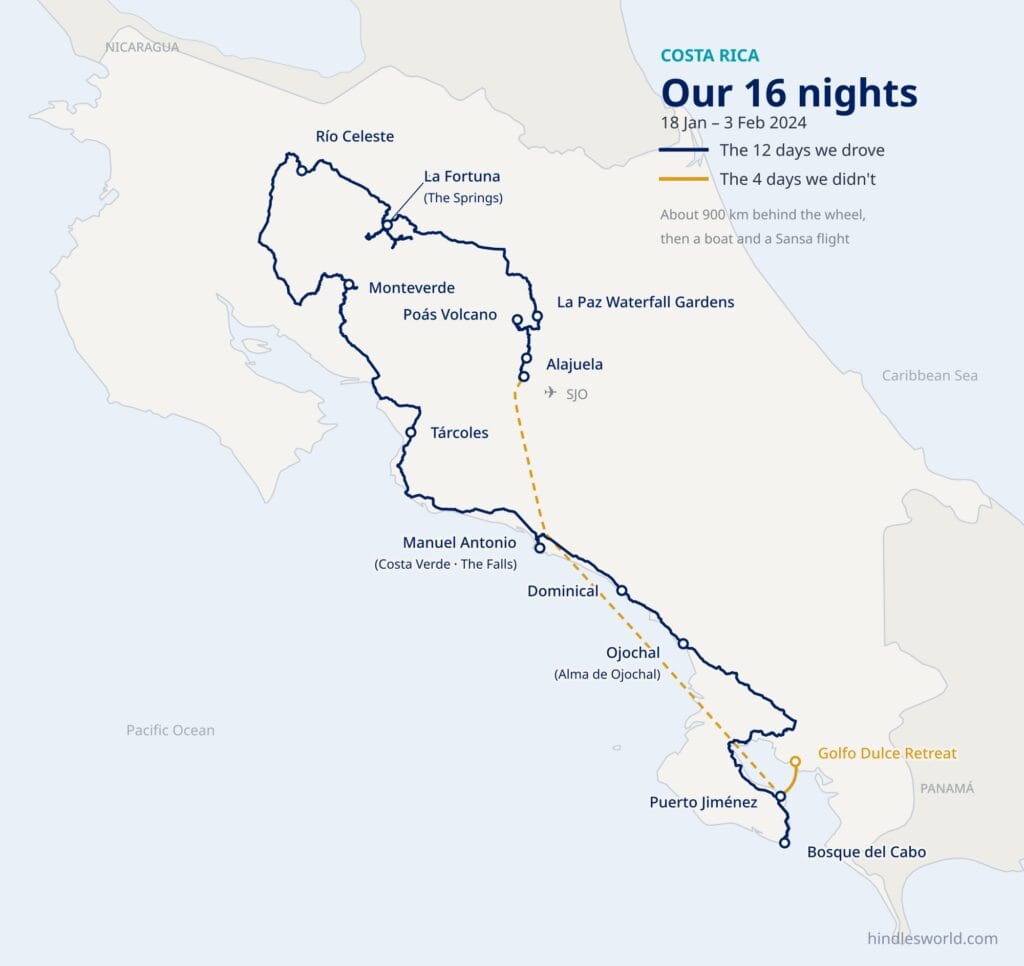
About an hour short of Bosque del Cabo, the satnav ran out of road. The tarmac had given up some time before. Ahead of us was a river with a ford across it, a bridge beside it that didn’t look much sturdier, and Mel, in the passenger seat, telling me very clearly that I was not allowed to drive through the ford.
Nobody had put that ford in our itinerary. We had. We’d hired the Land Cruiser, chosen the road and booked the lodge at the end of it. And we’d done all of it in a country whose language neither of us speaks.
On paper, this post answers a simple question for anyone weighing up Costa Rica self-drive holidays: should you use a travel agent, or book it all yourself? We got three quotes, then did it ourselves. We thought the answer would come down to money. It didn’t.
You can follow the whole journey in our three-part Costa Rica film series. This post covers what the films don’t: what the agents offered, why we turned them down, what that decision really cost, and what we’d tell a friend planning the same trip.
Why was Costa Rica such a big step for us?
We’re not new to planning our own travel. In spring 2016, a few months after I retired, we spent five weeks across Malaysia, Vietnam and Cambodia. I researched and booked almost all of it myself: seven flights within Asia, seven hotels, a cycling tour around Hoi An with a local guide, and a river boat to Battambang. The spreadsheet even had its own currency calculator for dong and riel.
The exception is telling. For the trickiest stretch, a junk through Bai Tu Long Bay, back to Hanoi, a night train to Sa Pa and three days of guided trekking, I went to a local operator in Hanoi. We negotiated a private tour for the four of us, quoted line by line. It was quite the adventure, and I’ve never regretted handing that part over.
So we’ve never been against agents, and the planning wasn’t the leap. But looking back at that 2016 spreadsheet, one phrase appears again and again: “Arrange transport”. Every time we moved, someone else did the moving: a pilot, a taxi driver, a boat crew, a train. Our job was to turn up on time.
Booking stuff you normally leave to someone else to sort
In Costa Rica, “arrange transport” meant me. Twelve days behind the wheel of a hire car, one way, from the airport outside San José to a dock on the Osa Peninsula: close to 900 km, or about 560 miles, once you add the side trips. Volcano entry slots that sell out. A national park ticket with a thirty-minute entry window. Roads that look fine on the map and turn out to be someone’s farm track.
And no Spanish. Beyond buenas and gracias, nothing. We hadn’t spoken Vietnamese or Khmer either, of course. But in Asia we were never the ones who’d have to explain a problem at the side of the road.
Booking a string of hotels, flights and tours is one thing. Driving yourself across a country you’ve never visited adds a layer of risk that’s hard to see from your sofa at home: road conditions, hire-desk small print, where it’s safe to leave the car, and what happens if something goes wrong a long way from anywhere. As it turned out, it was also the most alive we’ve ever felt on a trip.
Which is exactly why, in November 2023, we asked the professionals first.
What did the three travel agents offer?
We approached three quite different kinds of company. I’m not naming them. This isn’t a review of any of them, they were all helpful, and the type of company matters far more than the brand.
| What kind of company | How it works | What their plan looked like | |
| Company A | A well-known UK travel company with high-street shops and a big online presence | A UK-based consultant designs your trip and sells it to you as a package | Private transfers between regions and small-group tours with shared hotel pick-ups. A shorter, cheaper revision followed the first quote |
| Company B | An online platform that matches travellers with local travel specialists around the world | You chat with a specialist based in the country, who designs the trip and supports you on the ground | A choice of car-and-driver or a rental car, with small-group tours throughout |
| Company C | A Costa Rican destination management company (DMC) and custom travel agency | Human consultants on the ground build a tailored, all-in-one itinerary | A private driver for most legs, a shared van-boat-van across Lake Arenal, and the only quote itemised line by line |
All three covered the same broad loop: volcano, cloud forest, Pacific coast and a bit of jungle. All three clearly knew the country. Company C was especially candid; its small print even warned that we’d carry our own bags down to the boat.
What none of them could do was make the numbers make sense to me.
Why couldn’t we compare the quotes like-for-like?
The quotes ran from roughly £6,000 to £13,500 for two, before international flights. That’s somewhere between about £480 and £960 a night – a huge amount of money to spend on a trip. Bearing in mind we had booked the Business Class flights ourselves using our Avios “frequent flyer miles” (see this post on how we do that).
Even so: that’s a huge spread of quotes for roughly the same country. I spent forty years in catastrophe risk modelling, and a number I can’t explain is a number I don’t trust. So I built a spreadsheet.
It helped less than I’d hoped, for four reasons:
- Different trips. The quotes ran from 11 to 15 nights, and some revised versions dropped whole regions, such as the Caribbean coast (wrong time of year) or Drake Bay (we wanted to be on the Pacific Coast with better access to Corcovado National Park).
- Different rooms. Even where two quotes used the same hotel, they didn’t always use the same room. A garden studio and an ocean-view suite are not the same night’s sleep.
- Different ways of getting around. A private driver, a shared minibus and a self-drive 4×4 might reach the same volcano, but they’re not the same product.
- Different cancellation terms. This one caught me out. When we booked ourselves, we often paid more for rooms with free cancellation, because nobody stood between us and a change of plan. An agent would normally book cheaper, non-refundable trade rates and provide the flexibility themselves.
So any “we saved £X” or “the agent charged £Y” from us would be dishonest. We weren’t comparing like with like, and you wouldn’t be either.
Do travel agents add a markup?
Of course they do, and they should. Someone builds the itinerary, answers your emails and takes the call at 2am if a landslide closes the road. That work deserves paying for.
The surprise was how hard it was to see where the margin sat.
Two of the three quoted a single package price. Company B works that way by design: one price that bundles hotels, activities, transport and the specialist’s support. Company A’s quote had the same shape: a total, and a list of what was included.
Only Company C itemised everything, just as our Hanoi operator had in 2016, and that breakdown was an education. On the two hotels that appeared in both their quote and our own bookings, their rate was about a sixth lower than what we paid. Agents get trade rates, and Company C was clearly passing some of that on.
The margin lived in the pieces around the hotels instead: the transfers, an airport meet-and-greet, and a flat admin fee charged “per itinerary”. It was all perfectly disclosed. You’d just never see it without the itemised breakdown.
That’s worth knowing whoever you book with. An agent can be cheaper on the room and still dearer on the trip.
What did booking it ourselves actually involve?
In the end, money wasn’t what made us go it alone. The minibuses were. Several plans involved shared transfers and group pick-ups. The moment we asked about driving ourselves, the trip started to feel like ours.
So we thanked everyone politely, and Mel and I built it ourselves.
The result was a planning document I’m still slightly proud of. Every day has its drive time, a Plus Code for every turning, and every booking reference and cancel-by date. Poás Volcano at 10:40, because entry is timed. Manuel Antonio National Park between 07:00 and 07:30, booked through the government’s park website. “Check & photo everything!” next to the hire car. “Will need wet shoes for arrival” next to the boat to the Golfo Dulce.
Behind it sat more than a dozen separate bookings. Hotels came through Booking.com, Expedia and direct with the lodges. Tours came through Viator and park tickets direct from the parks. There was a one-way car hire, a domestic flight on Sansa, and international flights in and out on two different airlines.
An agent does all of that for you. Doing it yourself costs your evenings instead. We didn’t mind, but it’s worth being honest about.
Not everything on that document happened, and that’s rather the point. When you write the plan yourself, you’re allowed to rip bits of it up. For example, we skipped the Damas Island kayak as Mel’s shoulder was too sore.
Did booking it ourselves save money?
No. Our trip landed in the upper half of the agents’ range. Partly that was those flexible rates. Mostly it was because we chose dearer lodges, including the small, owner-run places that rarely appear on an agent’s list.
We’d spend the money the same way again on most of them. Not all of them. We’ll get to that in our TripWorthIt™ scores.
Why did self-driving change everything?
No quote can price this part of the decision.
Within an hour of landing, we were sitting in a Land Cruiser in a San José traffic jam. By the next afternoon, the satnav had sent us down a track to The Springs that delivered us, at one point, into someone’s front yard. Mel’s commentary on that stretch doesn’t need repeating.
We’d read the warnings about driving after dark and took them seriously, which is why our first night was a short hop from the airport, not three hours into the dark. On the road south to the coast, we waited behind convoys of lorries grinding up the hills. At the crocodile bridge over the Río Tárcoles, we worried more about the car than the crocodiles, because thefts from parked cars there are well reported. And on the way to Osa, we came down a descent so steep that neither of us could see the road over the bonnet.
None of it turned out to be dangerous. All of it was ours to handle. There was no driver to defer to and no rep to ring. It was just us, a voucher full of small print, and whatever Spanish we could muster.
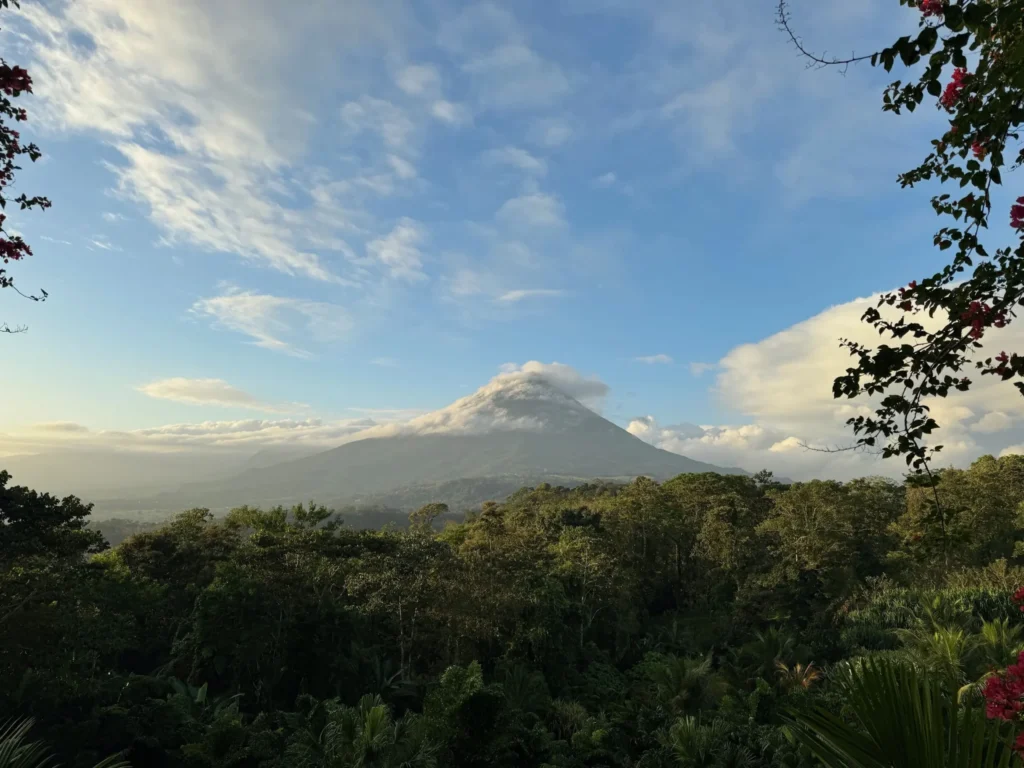
But the car also gave us the trip’s best surprises. Driving yourself means you can change your mind, and on day two we did. A plan we hadn’t made took us to La Paz Waterfall Gardens, to blue morpho butterflies drying their wings and to a waterfall we hadn’t known existed the day before. On the long drive around the lake to Monteverde, the car meant a detour to Río Celeste, in steady rain, for water so improbably blue that we explain it in the first film. Heading south, it meant an hour in the surf town of Dominical. Mel’s verdict: if we were younger, we’d have moved in.
That’s the trade. An agent sells you certainty. A car and a blank page sell you possibility, and you carry the risk.
What would an agent have told us that we learned the hard way?
Quite a lot, to be fair to them. Our homemade itinerary had gaps that local knowledge would have filled:
- Monteverde at lunchtime. We booked a 1pm walk in the Cloud Forest Reserve. Around 80% of the region’s animals are nocturnal, so midday in the cloud is not prime time. A local planner might well have steered us towards an early start or a night walk.
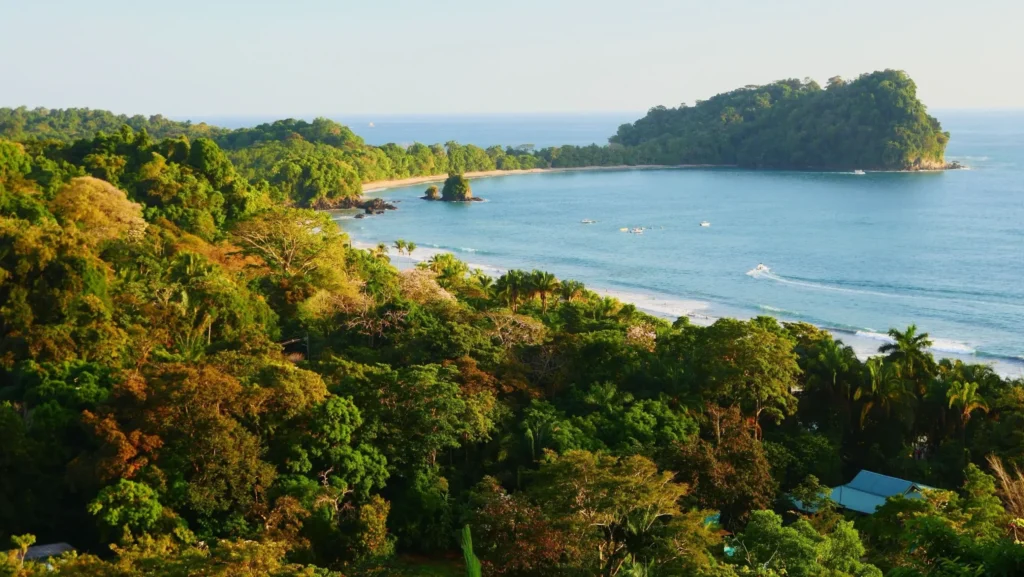
- Manuel Antonio National Park. It was crowded enough to spoil the morning, and we saw more wildlife from our hotel up the road. Someone on the ground might have warned us.
- The car at the end. Once we reached Bosque del Cabo, we didn’t need the car at all; there was far too much to do at the lodge. We’d have done better dropping it in Puerto Jiménez first and getting a lift.
- Where to stay in Manuel Antonio. One night at The Falls made us wish we’d booked it for all three.
None of this spoiled the trip. But it’s exactly the kind of knowledge you’re paying for when you pay an agent.
Does a travel agent protect your money?
Sometimes. This is the point I’d most want a friend to understand before booking.
If you book a package with a UK-based travel company, you get real protection. A package that includes flights should come with an ATOL certificate. A package without flights should still be covered by the organiser’s insolvency protection, often through ABTA. You also have one company legally responsible for delivering the whole package as sold.
But that protection comes from booking a package with a UK organiser, not simply from “using an agent”. A platform based overseas or a local company in Costa Rica may offer guarantees of its own, but they won’t be the UK schemes. One company we spoke to offers its own optional cancellation cover and is careful to point out that it isn’t travel insurance. Ask every company, in writing, what protects your money if they fail.
Book everything yourself, as we did, and you have none of that. More than a dozen bookings mean more than a dozen sets of terms. Your safety net is your travel insurance, your credit card and the cancellation policy you chose for each booking.
Travel agent or DIY: the pros and cons
| Using a travel agent | Booking it yourself | |
| Price | Trade rates can make hotels cheaper; the margin sits in transfers, fees and the package total | You see every price, but you pay public rates, and more again for free cancellation |
| Seeing the numbers | Depends on the company. Only one of our three itemised its quote | Complete. You made every booking |
| Local knowledge | Their biggest asset: timings, crowds, road conditions, which lodge suits you | Learned on the road, sometimes the hard way |
| Planning time | Theirs | Yours, and plenty of it |
| Choice of hotels | Their contracted list; budgets are often met by swapping in simpler hotels | Any property, including small owner-run lodges agents rarely carry |
| Getting around | Private drivers and transfers, though some legs and tours are shared with other travellers | A car and complete freedom, plus all the driving risk |
| Changing plans on the ground | Through the agent, around fixed pick-ups and tour times | Whenever you like, but the change fees are yours |
| Money protection (UK travellers) | A UK organiser’s package: ATOL with flights, insolvency protection without. Overseas companies: their own terms | None beyond each supplier’s terms, your insurance and your credit card |
| When something goes wrong | One phone number, often someone local who speaks the language | You, and whatever Spanish you can muster |
| Cancellation | One set of package terms, usually deposit-based | A dozen sets of terms; you choose (and pay for) each one |
| The story you come home with | A well-run trip designed by someone who knows the country | Your trip, mistakes included |
Should you use a travel agent for Costa Rica?
There’s no wrong answer here, only a wrong match.
Use an agent if
- It’s your first trip to Central America and you’d rather someone else worried about the logistics
- You don’t want to drive (the roads are fine; the potholes have opinions)
- You want one phone number when things go wrong, and UK package protection
- Well-reviewed mid-range hotels suit you, and you’d like the trade rate
Book it yourself if
- You’ve already found the lodges you want, especially the small, owner-run ones
- You want to set your own pace, stop when you see a sloth and skip the group pick-ups
- You can live with change fees, a hefty card deposit at the hire desk and a fair few evenings of planning
Either way, do what I wish I’d done sooner
- Ask every agent for an itemised quote. If they won’t break it down, that tells you something too.
- Price two or three of their hotels yourself, on the same dates and in the same room type. That shows you whether the margin is in the rooms or the extras.
- Look for admin, meet-and-greet and “per itinerary” fees, and ask which transfers and tours are shared.
- Ask, in writing, what protects your money if the company fails.
- Price the transfers against a car for the same days. Then work out when you can hand the car back early.
What we really learned
We set out to answer a money question. We came home with a different one: how much of the trip do you want to carry yourself?
Carrying it cost us a lot of evenings, a few mistakes and one long look at a ford. In return, it gave us Río Celeste on a whim, a surf town we’d never heard of, and a road to the far end of the Osa Peninsula that no agent had suggested. What we found at the end of that road belongs to the third film.
For more on the route itself, our Costa Rica self-drive itinerary has the day-by-day, and our guide to self-guided tours in Costa Rica covers the tours we booked on our own.
Your turn: have you ever booked a trip with an agent and then wondered whether you’d have done better on your own? Or the other way round? Tell us in the comments.
Costa Rica travel agent vs DIY: your questions answered
Not necessarily, and it wasn’t for us. Agents get trade rates on hotels, so the same room can cost less through them. Where you can save by booking yourself is on tours and transfers, and by choosing exactly where your money goes. We spent ours on dearer lodges and flexible rates, so we ended up in the upper half of the agents’ range.
Yes, and that’s fair. They’re doing real work. The trouble is seeing it. Two of our three quotes were single package prices. The one company that itemised was actually cheaper than us on hotels, and its margin sat in transfers, a meet-and-greet and a per-itinerary admin fee.
Only if you book a package with a UK-based organiser. A flight-inclusive package should come with an ATOL certificate, and a package without flights should still have insolvency protection, often through ABTA. Overseas platforms and local Costa Rican companies won’t be covered by those UK schemes, so ask what does protect you. If you book everything separately, you’re relying on travel insurance and your credit card.
We found it manageable. Google Maps worked better than Waze. The main rules we followed were to avoid driving after dark, never leave anything in a parked car at tourist stops like the Tarcoles crocodile bridge, and allow far longer than the satnav says on the back roads. The language barrier matters most at the hire desk and if something breaks down, so read your rental terms carefully before you land.
For our route, we were glad of one. The road to our hotel near Arenal was rough, (and we blame Waze for taking us the wrong way). Generally though there are fewer pot holes than in England! The last hour to Bosque del Cabo is unpaved with a river crossing option. If you’re sticking to the main towns and highways, a smaller car would cope. Once you reach a remote lodge, though, you may not need a car at all.
Check with the rental company if they accept drop off at a different location. We chose Alamo because they accepted that, but it restricted the choice and increased the price. We picked our 4X4 up at San José (SJO) airport and dropped at Puerto Jiménez (PJM).
Book the car, lodges in popular or remote areas, and any national park with timed entry. Poás Volcano and Manuel Antonio both ran timed slots when we went, booked online in advance. Guided tours can usually wait a little longer, but book the popular ones before you fly.


💬 Share Your Thoughts
We love hearing from fellow travellers. Whether you have a question, a tip, or your own story to add, please jump in! We reply to every comment personally.